
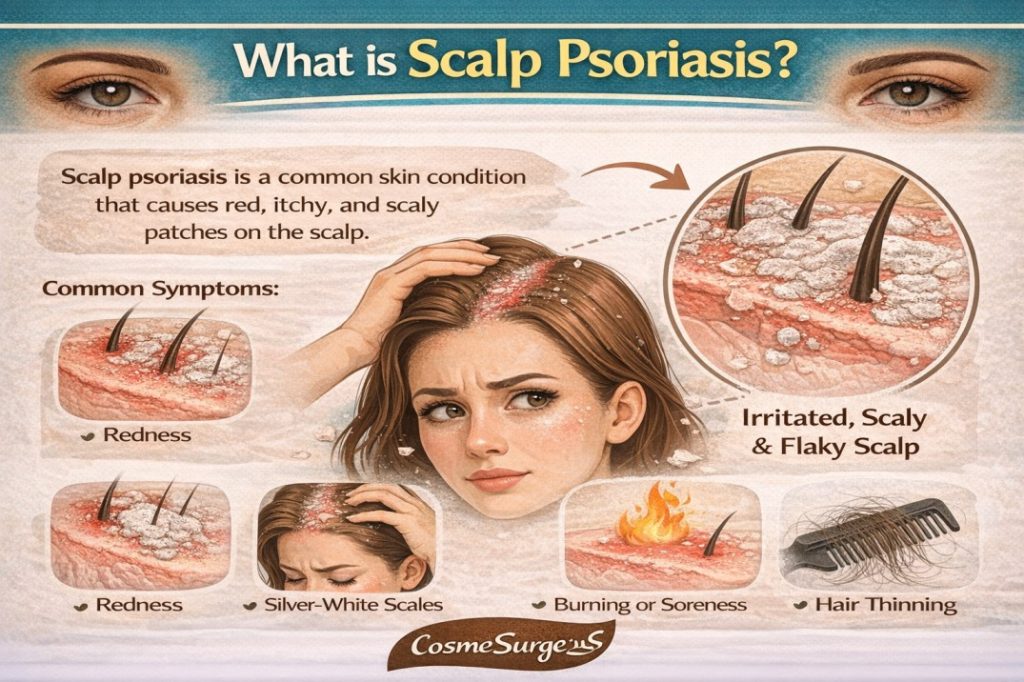
What is Scalp Psoriasis?
Scalp psoriasis is a chronic autoimmune condition that causes red, scaly patches on the scalp. It occurs when the immune system triggers skin cells to grow 5-7 times faster than normal, leading to a buildup of thick, silvery scales. It is not contagious and affects approximately 2-3% of the global population.
How Common is Scalp Psoriasis?
Scalp psoriasis is one of the most common yet misunderstood skin conditions affecting millions worldwide. If you have been struggling with persistent silvery-white flakes that do not respond to regular dandruff shampoos, a “tight” feeling across your scalp, or red, raised patches that extend beyond your hairline, you may be experiencing psoriasis on scalp.
In this comprehensive guide, our dermatology specialists at CosmeSurge Hospital, Dubai, UAE explain everything you need to know about scalp psoriasis symptoms, causes, and the most effective treatment options available today.
In This Article
What Is Scalp Psoriasis? (Definition & Cell Biology)
Recognizing Scalp Psoriasis Symptoms
Scalp Psoriasis vs Dandruff: Key Differences
Scalp Psoriasis Causes and Triggers
Diagnosis: What to Expect at Your Consultation
Treatment Options: Topical, Phototherapy & Biologics
Living with Scalp Psoriasis in the UAE
FAQs About Scalp Psoriasis
What Is Scalp Psoriasis? Understanding the Condition
Scalp psoriasis is a chronic inflammatory autoimmune condition that causes thick, red, scaly patches (called plaques) to form on the scalp. According to the National Psoriasis Foundation, approximately 50% of people with psoriasis experience symptoms on their scalp at some point.
How Does Scalp Psoriasis Develop? (The Cell Biology)
In a healthy scalp, new skin cells form deep within the skin and gradually migrate to the surface over approximately 28-30 days. Once they reach the top, they shed naturally, usually without notice.
With scalp psoriasis, this process accelerates dramatically. The immune system sends faulty signals that cause skin cells to mature in just 3-5 days — roughly 5-7 times faster than normal. Because the body cannot shed the old cells quickly enough, they pile up on the scalp surface, forming the characteristic thick, silvery-white scales.
💡 Key Point
Scalp psoriasis is NOT caused by poor hygiene. It is a chronic immune-mediated condition that requires proper medical management, not just stronger shampoo.
Scalp Psoriasis Symptoms: How to Recognize the Condition
The most common scalp psoriasis symptoms include red, raised patches covered with silvery-white scales; intense itching (especially at night); a burning or soreness sensation; dry scalp that may crack and bleed; and temporary hair thinning in affected areas.
The Hallmark Sign: Silvery Scaling
The defining characteristic of scalp plaque psoriasis is the presence of red patches covered with silvery-white scales. In mild cases, these scales appear “fine” or “powdery.” In severe cases, they become thick and “micaceous” (layered like mica stone).
The Auspitz Sign and Pinpoint Bleeding
Unlike simple dry skin, scalp psoriasis affects the tiny blood vessels beneath the skin surface. If a scale is accidentally scratched or removed, the area may bleed in small, pinpoint spots — this is known as the Auspitz sign, a clinical indicator that helps dermatologists distinguish psoriasis from other conditions.
Does Scalp Psoriasis Cause Hair Loss?
Scalp psoriasis hair loss is a common concern among patients. The good news: psoriasis itself does not damage hair follicles permanently. However, thick scaling can temporarily interfere with hair growth, and vigorous scratching may push follicles into a resting phase (telogen effluvium), causing shedding.
Once inflammation is controlled and scales are removed, hair typically returns to its normal growth cycle.

Scalp Psoriasis vs Dandruff: How to Tell the Difference
The key difference between scalp psoriasis vs dandruff lies in the appearance and location of flakes. Dandruff (seborrheic dermatitis) produces greasy, yellowish flakes limited to oily scalp areas. Psoriasis causes dry, thick, silvery-white scales that often extend beyond the hairline onto the forehead, neck, and behind the ears.
Feature | Scalp Psoriasis | Dandruff |
Scale Appearance | Thick, silvery-white, dry | Thin, yellowish, greasy |
Location | Scalp + beyond hairline | Oily areas of scalp only |
Bleeding When Scratched | Yes (Auspitz sign) | No |
Responds to OTC Shampoo | No — requires medical treatment | Yes — often improves |
Underlying Cause | Autoimmune dysfunction | Yeast overgrowth / sebum |
Scalp Psoriasis vs Eczema: What Is the Difference?
When comparing scalp psoriasis vs eczema, the key distinction is in the plaque characteristics. Psoriasis produces thick, well-defined, silvery patches with sharp borders. Eczema (atopic dermatitis) tends to be more inflamed, itchy, and less sharply defined, often appearing as red, oozing, or crusty areas without the characteristic silver scaling.
What Causes Scalp Psoriasis? Triggers and Risk Factors
Understanding scalp psoriasis causes requires looking at both genetic and environmental factors. Research published in the Journal of the American Academy of Dermatology confirms that psoriasis involves a complex interplay between genetics, immune dysfunction, and external triggers.
1. Genetic Predisposition
According to the National Psoriasis Foundation, approximately one-third of people with psoriasis have a family member with the condition. Specific genes (such as HLA-Cw6) are associated with higher psoriasis risk, though having these genes does not guarantee you will develop symptoms.
2. Immune System Dysfunction
Psoriasis is fundamentally an autoimmune condition. T-cells (a type of white blood cell) mistakenly attack healthy skin cells, triggering rapid cell production and inflammation.
3. Environmental Triggers
Stress: High cortisol levels activate inflammatory pathways
Skin Injury (Koebner Phenomenon): Scratching, sunburn, or cuts can trigger new patches
Infections: Strep throat is a known trigger, especially in children
Weather Extremes: Cold, dry air worsens symptoms; the UAE’s AC-heavy environments can contribute
Medications: Certain drugs (lithium, beta-blockers, antimalarials) may trigger or worsen flares
Living in the UAE?
The extreme heat outdoors combined with cold, dry air-conditioning indoors creates a challenging environment for scalp health. This constant temperature shift can compromise your skin barrier and trigger flares. Consider using a humidifier at home and rinsing your scalp with fresh water after pool or beach exposure.
How Is Scalp Psoriasis Diagnosed?
At CosmeSurge Hospital, Dubai, UAE, our dermatologists follow a comprehensive diagnostic process to ensure accurate identification and rule out similar conditions.
Physical Examination
Your specialist will examine not just your scalp, but also your nails (looking for “pitting” or oil spots), elbows, and knees. Psoriasis is a systemic condition, and clues often appear in these areas.
Differential Diagnosis
Your dermatologist must rule out conditions that mimic scalp psoriasis:
Tinea Capitis: Fungal infection causing scaling and broken hairs
Lichen Planus: Inflammatory condition that can cause scarring and permanent hair loss
Seborrheic Dermatitis: The most common “mimic” (dandruff)
In complex cases where symptoms overlap, a small 3mm skin biopsy under local anesthesia may be performed to ensure accurate diagnosis.

Scalp Psoriasis Treatment: A Tiered Approach
Effective scalp psoriasis treatment follows a tiered approach, starting with topical therapies and escalating to systemic treatments when needed.
Tier 1: Topical Treatments (First-Line)
Keratolytics (Salicylic Acid): Soften and remove thick scales so other medications can penetrate
Topical Corticosteroids: Reduce inflammation and itching (ranging from mild to ultra-potent formulations)
Vitamin D Analogues: Slow skin cell growth (e.g., calcipotriol)
Coal Tar Preparations: Reduce scaling, itching, and inflammation (modern formulations are odor-free)
Tier 2: Phototherapy (Light Treatment)
When topicals are insufficient, Narrowband UVB phototherapy uses specific wavelengths of ultraviolet light to slow cell growth and suppress overactive T-cells. For scalp-specific treatment, excimer lasers target individual plaques without affecting surrounding healthy skin.
Tier 3: Systemic and Biologic Therapies
For moderate to severe cases, or when scalp psoriasis significantly impacts quality of life, systemic treatments may be recommended:
Oral Medications: Methotrexate, cyclosporine, or apremilast calm the overactive immune response
Biologic Therapies: Injectable medications (such as adalimumab, secukinumab, or ixekizumab) target specific inflammatory proteins (TNF-alpha, IL-17, IL-23) for highly targeted treatment
Take the Next Step: Expert Care at CosmeSurge Hospital Dubai
Living with scalp psoriasis requires patience and proactive management — but you do not have to manage it alone. At CosmeSurge Hospital, Dubai, UAE, our board-certified dermatologists specialize in diagnosing and treating all forms of psoriasis, from mild scalp involvement to complex cases requiring biologic therapy.
Book your consultation today and take the first step toward a clearer, more comfortable scalp.

Frequently Asked Questions About Scalp Psoriasis
Here are some answers to the specific questions we often hear but didn’t cover in detail above.
No. Scalp psoriasis is NOT contagious. You cannot catch it from a hairbrush, swimming pool, or physical contact. It is an autoimmune condition driven by genetics and immune system dysfunction.
Yes, but only when your scalp is not in an active flare. If your scalp is cracked or bleeding, hair dye chemicals can cause severe irritation. Always inform your stylist and consider a patch test first.
Controlled amounts of natural UV light can help reduce symptoms. However, sunburn is a skin injury that can trigger new plaques (Koebner phenomenon). Moderation is essential.
Yes. Scalp psoriasis does not cause permanent scarring of hair follicles in most cases. Once inflammation is controlled and scales are removed, hair typically returns to its normal growth cycle.
Yes. Stress is one of the most powerful documented triggers for psoriasis flares. High cortisol levels activate inflammatory pathways in the skin. Stress management is an important part of long-term control.
Untreated scalp psoriasis can lead to secondary bacterial infections (from scratching), significant discomfort, and potential psoriatic arthritis — which affects the joints in approximately 30% of people with psoriasis.
Yes. Scalp psoriasis can appear in childhood, though peak onset ages are typically 15-25 and 50-60 years old.
Scalp plaque psoriasis is the most common type of scalp psoriasis. It appears as thick, red patches covered with silvery-white scales that may itch, flake, or feel sore.
While oils like coconut, jojoba, or aloe vera are excellent for soothing the skin and softening scales, they do not treat the underlying immune signal. They are best used as adjuncts to medical therapy.
If your scalp is bleeding, if the itching is preventing you from sleeping, or if you are experiencing joint pain along with your scalp issues, it is time for a professional clinical evaluation.
Medical Disclaimer & Review
This content is for educational purposes only and does not replace professional medical advice. Always consult a qualified healthcare provider for diagnosis and treatment.
Medically reviewed by the CosmeSurge Dermatology Team, Dubai, UAE.
Related Posts
Saline vs Silicone Breast Implants: Which Is Better? Key Takeaways...Read More
How Long Does Botox Last? Timeline, Results & Duration Key...Read More
Daxxify vs Botox: Which Wrinkle Treatment Is Right for You?...Read More
Panniculectomy vs Tummy Tuck: Key Differences Explained Key Takeaways: Panniculectomy...Read More