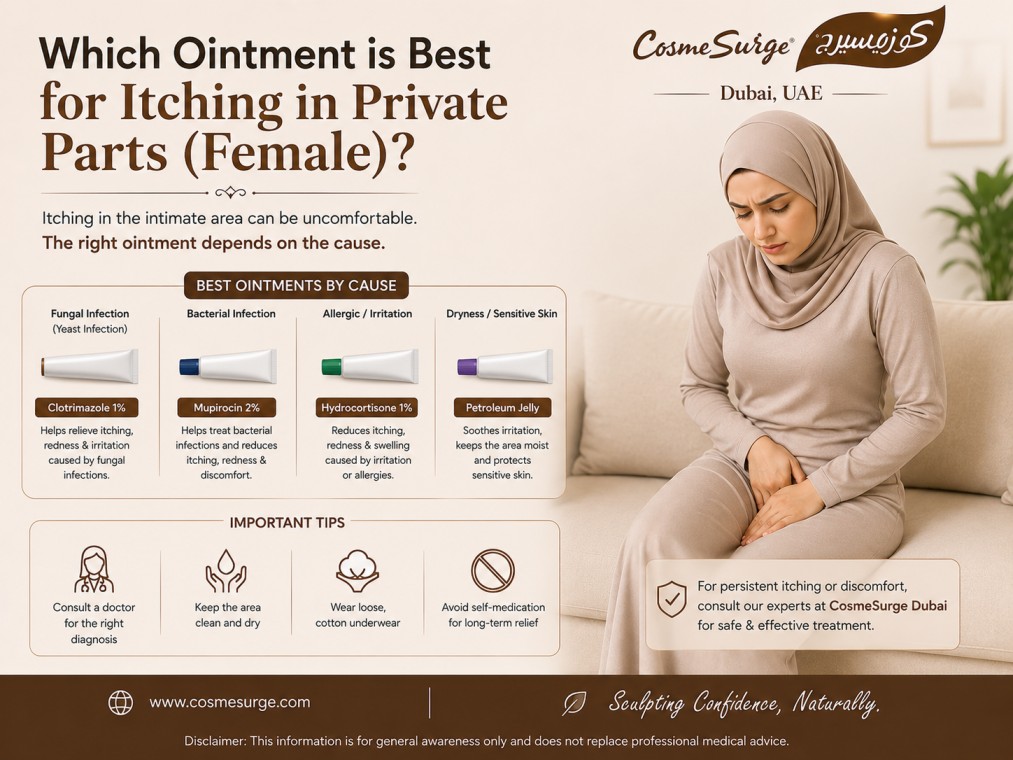
When vaginal itching strikes, many women head straight to the pharmacy looking for relief. But with so many options available – antifungal creams, hydrocortisone, prescription medications – choosing the right medicine for itching in private parts for female can be confusing.
At CosmeSurge Hospital UAE, our gynaecologists help women find the most effective treatment for their specific condition. This guide explains the different types of vaginal itching cream and ointments available and when to use each one.
Understanding Which Treatment You Need
The best cream for vaginal itching depends entirely on what is causing the itch. Using the wrong treatment can delay healing or make things worse.
Yeast infection → Antifungal cream or suppository
Bacterial vaginosis → Prescription antibiotics (not OTC)
General irritation/dermatitis → Hydrocortisone cream (external only)
Vaginal dryness → Vaginal moisturisers or oestrogen cream
Over-the-Counter Options for Vaginal Itching
1. Antifungal Creams and Suppositories (For Yeast Infections)
If you suspect a yeast infection, antifungal treatments are your first line of defence.
Common active ingredients:
Miconazole (Monistat) – Available in 1, 3, or 7-day treatments
Clotrimazole (Canesten) – Cream, tablet, or combination packs
Tioconazole – Single-dose application
How to use: Insert suppository or applicator cream internally as directed; apply external cream to vulvar area for external itching
Best for: Confirmed or suspected yeast infections with typical symptoms (thick white discharge, intense itching)
2. Hydrocortisone Cream (For External Irritation)
Low-strength hydrocortisone (0.5%-1%) is a mild corticosteroid that reduces inflammation and itching.
How to use: Apply a thin layer to external vulvar area only; do NOT use internally; limit use to 7 days
Best for: Contact dermatitis, allergic reactions, general external irritation
Not for: Infections – hydrocortisone can worsen fungal and bacterial infections if used incorrectly
3. Vaginal Moisturisers (For Dryness-Related Itching)
If itching is caused by vaginal dryness, moisturisers provide longer-lasting hydration than lubricants.
Options: Replens, Hyalofemme, K-Y Liquibeads
How to use: Apply internally as directed, typically every 2-3 days
Best for: Menopausal dryness, post-childbirth dryness, medication-induced dryness
Prescription Treatments for Vaginal Itching
1. Oral Fluconazole (Diflucan)
A single-dose oral antifungal tablet that treats yeast infections from within.
Best for: Severe or recurrent yeast infections, when OTC treatments fail
2. Topical Oestrogen Cream
For itching caused by vaginal atrophy (thinning due to low oestrogen), topical oestrogen restores vaginal tissue health.
Options: Premarin cream, Estrace, Vagifem tablets
Best for: Menopausal women with vaginal dryness and atrophy
3. Antibiotic Creams or Tablets
For bacterial vaginosis, prescription antibiotics (metronidazole gel/cream or clindamycin) are required.
Note: BV cannot be treated with over-the-counter products
4. Prescription-Strength Corticosteroids
For chronic skin conditions like lichen sclerosus or severe dermatitis, stronger corticosteroid creams may be prescribed.
 [Read our complete guide: Why Is My Vagina Itchy Inside]
Important Safety Tips
Never use hydrocortisone cream internally
Do not use antifungal treatments if you are unsure about the cause
Avoid scented or flavoured products in the vaginal area
Complete the full course of any treatment, even if symptoms improve
If OTC treatments do not work within 7 days, see a doctor
Need Help Choosing the Right Treatment?
Our gynaecology team at CosmeSurge Hospital UAE can diagnose your condition and recommend the most effective treatment.
How to Choose the Right Treatment
Ask yourself these questions:
Do I have unusual discharge? → If yes, likely infection (yeast or BV)
Did symptoms start after using a new product? → Likely contact irritation
Am I menopausal or breastfeeding? → Consider dryness-related causes
Is this recurring? → See a doctor for proper diagnosis
When in doubt, consult a gynaecologist at CosmeSurge Hospital UAE rather than guessing with OTC products.
Medical Disclaimer & Review
This content is for educational purposes only and does not replace professional medical advice. Always consult a qualified healthcare provider for diagnosis and treatment.
Medically reviewed by the CosmeSurge Gynaecology Team, Dubai, UAE.