
Key Takeaways It is completely normal for breasts to appear flat or deflated immediately after breast implant removal. The loss of implant volume, skin stretching, and tissue adjustment all contribute to changes in shape during the recovery period. What to know:
Specialists at CosmeSurge provide personalised treatment plans following breast implant removal, supporting women through every stage of their recovery and reconstruction journey. |
Why Do Breasts Look Flat After Breast Implant Removal?
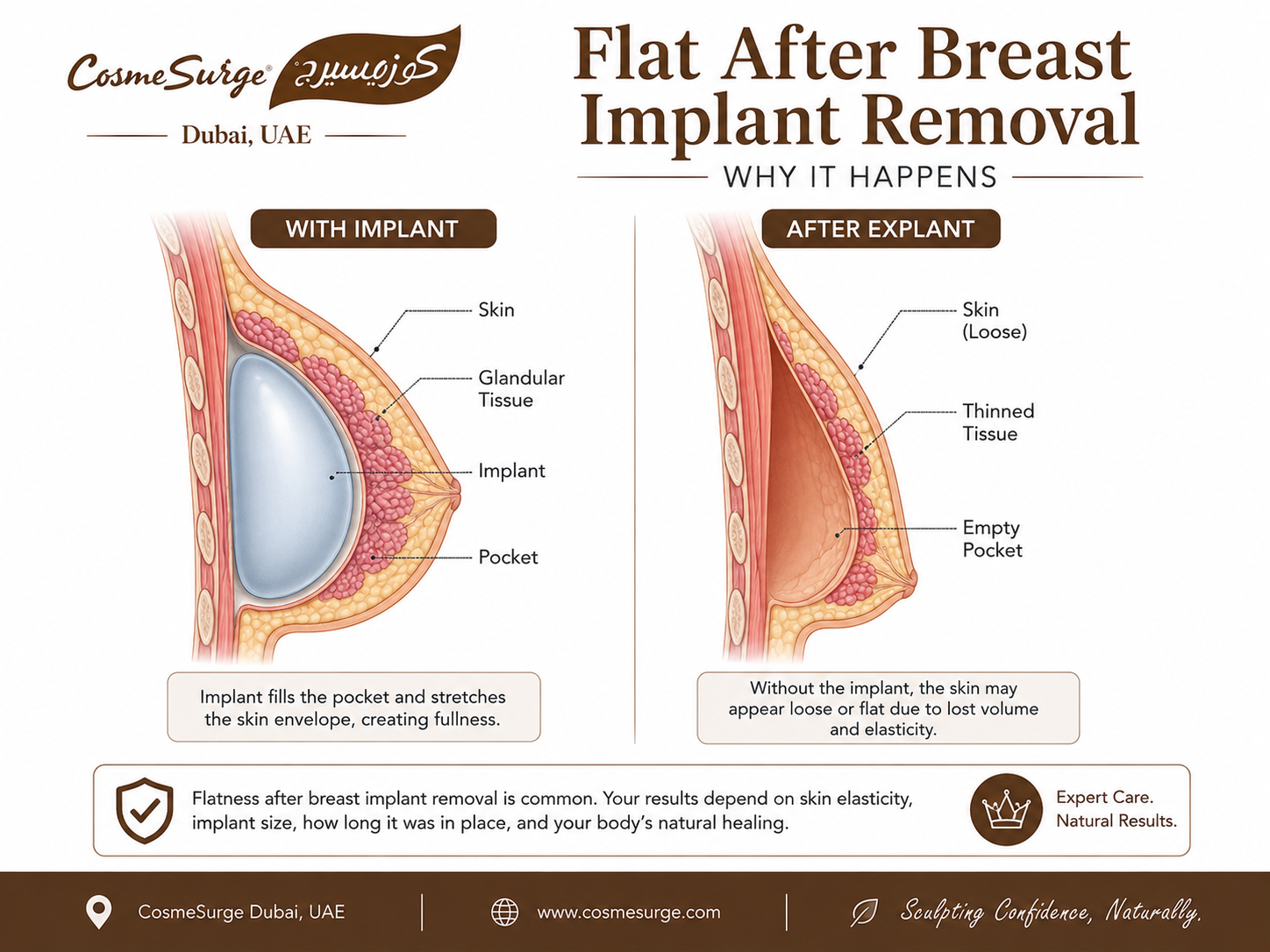
The flatness most women notice immediately after explant surgery is the direct result of removing a volume that has been present — sometimes for many years — inside the breast pocket. That volume had been providing shape, projection, and fullness. When the implant is gone, the breast tissue and skin that were draped around it now have nothing to rest on.
The degree of flatness depends on several overlapping factors.
Loss of Implant Volume
This is the most straightforward explanation. A 400cc implant, for example, represents a significant portion of the breast’s overall volume. When that volume disappears in a single surgical procedure, the immediate visual result is a substantially flatter chest.
Skin Stretching and Thinning
Over the years an implant is in place, the overlying skin and tissue gradually expand to accommodate it. When the implant is removed, that stretched skin does not immediately contract. The result is an envelope that is now too large for its contents — leading to loose skin, wrinkles, and a deflated or saggy appearance.
Tissue Thinning
Long-term implant presence can compress the natural breast tissue beneath and around it. In some women, particularly those who had implants placed for many years, the native glandular tissue has thinned considerably. This means there is less natural tissue to “fill in” the space the implant once occupied.
Implant Size and Duration
Women who had larger implants or who wore them for longer periods tend to experience more pronounced flatness after removal. The skin and tissue have adapted more significantly to the implant’s presence, making the adjustment after removal more noticeable.
Age and Skin Elasticity
Younger skin has a greater capacity to contract and remodel after implant removal. Older skin, or skin that has been stretched repeatedly through pregnancy and weight changes, has less inherent elasticity and is less likely to bounce back on its own.
Is It Normal to Feel Flat After Breast Implant Removal?
Yes — completely. Feeling flat after breast implant removal is one of the most commonly reported experiences following explant surgery, and it is expected rather than exceptional.
In the days immediately following surgery, swelling, bruising, and the tight compression garments required for healing can make the chest appear even flatter and more unfamiliar than it will ultimately look. What you see in the first week is not what you will have in six months. This is an important distinction to hold onto during a period when the emotional impact of the change can feel significant.
The early recovery phase is often the hardest — both physically and emotionally. Women who chose explant surgery for health reasons sometimes find themselves grieving the loss of a shape they had grown accustomed to, even when they were certain the removal was the right decision. This is entirely normal and does not mean anything has gone wrong.
Changes over the following weeks and months are genuine and meaningful. The tissue begins to settle, the skin starts to contract, and the breast starts to take on a shape that reflects what your natural anatomy — after years with an implant — looks like now.
What Is "Fluffing" After Explant Surgery?
“Fluffing” is the term used in the explant community to describe the natural process of tissue settling, skin contracting, and remaining breast fat redistributing after an implant has been removed. It refers to the gradual softening and reshaping that occurs as the body adapts to the change in its internal environment.
Immediately after surgery, the chest wall, pectoral muscles, and remaining breast tissue are all in a state of compression and inflammation. As healing progresses, the muscles relax, swelling reduces, and the skin begins to retract inward — allowing whatever natural tissue remains to assume a more natural position and projection.
Fluffing after explant is not a dramatic transformation. It is a slow, incremental process that unfolds over weeks and months rather than days. Many women notice the most noticeable changes between month two and month six post-surgery. Some continue to see improvement up to 12 months after the procedure.
How much fluffing occurs varies considerably between individuals. Women with good natural tissue volume and skin elasticity tend to see more significant improvement. Women with very thin tissue or significantly stretched skin may notice less change from the fluffing process alone.
It is worth being realistic: fluffing after explant can improve breast appearance meaningfully, but it cannot replace the volume that was provided by the implant. For women who want additional volume or significant shape correction, surgical options such as breast lift or fat transfer offer more predictable results.
How Long Does It Take for Breasts to Recover After Explant Surgery?
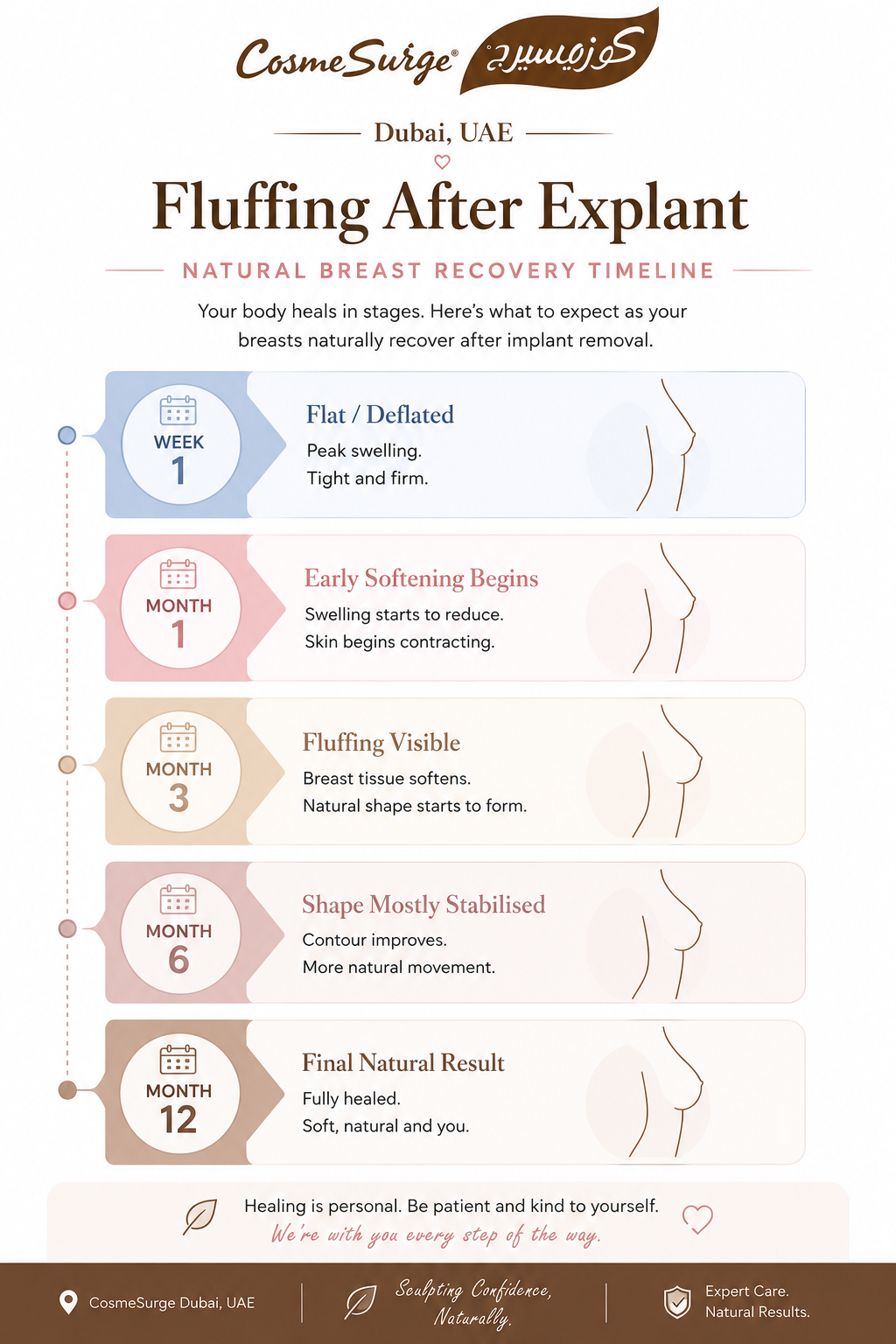
Recovery follows a broadly predictable pattern, though the timeline varies between individuals. Here is a realistic overview of what to expect at each stage:
Timeframe | What to Expect | Appearance |
Week 1 | Swelling and bruising peak; dressings or drains may be in place; rest essential | Breasts appear very flat or deflated; significant bruising around the chest |
Month 1 | Swelling gradually reduces; skin begins contracting; fluffing process starts | Early tissue softening; shape begins to emerge; still noticeably flatter than before |
Month 3 | Fluffing more visible; fat redistribution underway; most bruising resolved | Contour improves in many patients; upper pole softens; light exercise permitted |
Month 6 | Most of the fluffing process complete; skin elasticity approaches final position | Shape largely stabilised; women with good elasticity see the most improvement |
Year 1 | Final result fully visible; skin has adapted as much as it will naturally | Definitive outcome — patients seeking further improvement can now discuss lift or fat transfer |
The most important message about recovery: do not judge your final result in the first month. The appearance of the breasts in weeks one to four is almost never the final outcome. Patience is one of the most genuinely useful things during this period.
Side Effects of Breast Implant Removal
Beyond flatness — the most discussed side effect — breast implant removal can produce several other physical changes that are worth understanding before the procedure.
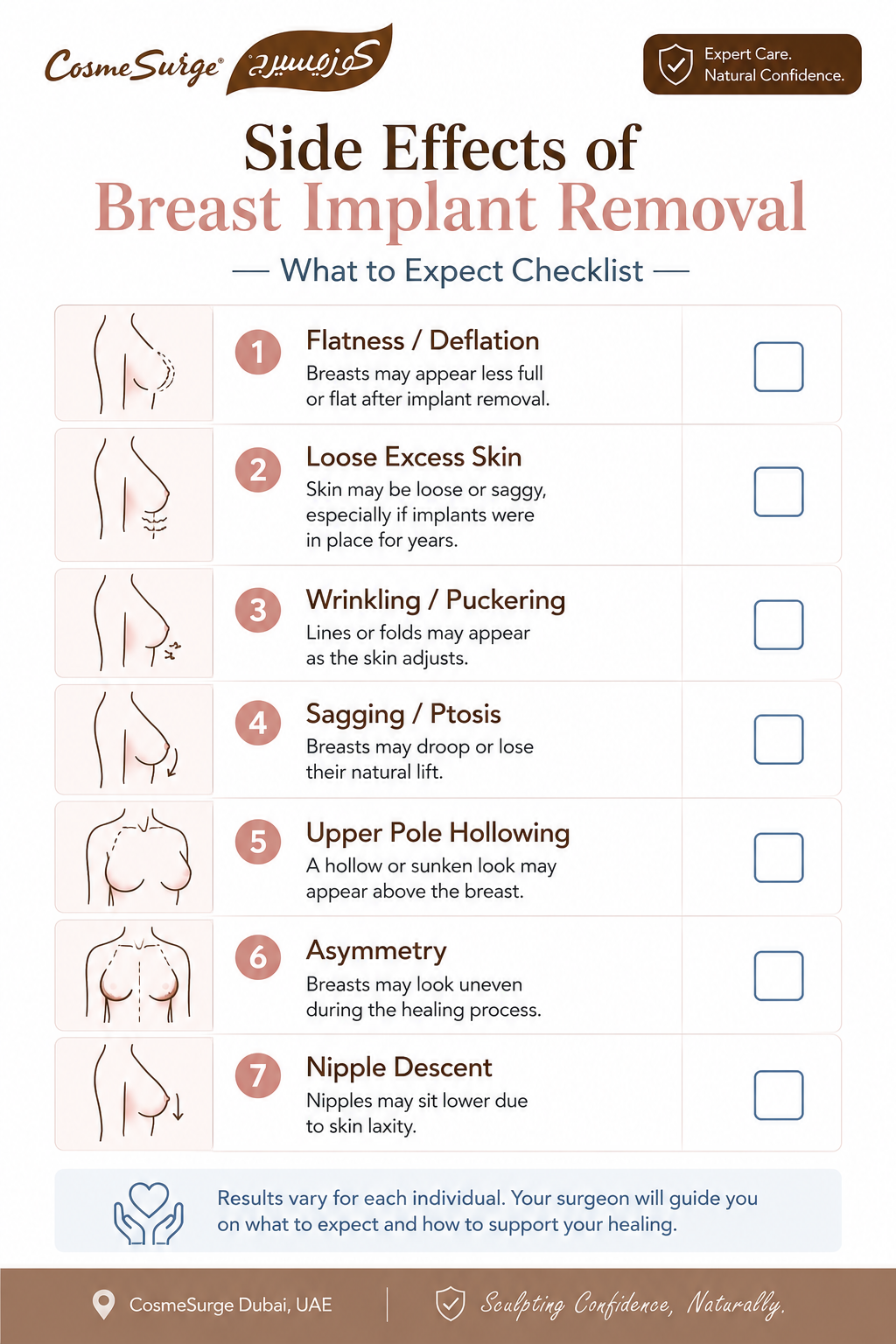
Loose or excess skin: Particularly visible around the lower pole and sides of the breast. The degree of laxity depends on implant size and duration.
Wrinkling or puckering: The skin, no longer supported from beneath by the implant, may develop visible wrinkles or a creased appearance, particularly in thinner women.
Sagging (ptosis): Without the implant providing forward projection, the natural breast tissue — particularly in patients with pre-existing ptosis — may sag more noticeably than before surgery.
Loss of upper pole fullness: Implants — especially those placed sub-glandularly or with significant projection — provide a fullness in the upper part of the breast that disappears completely after removal. The upper chest may look noticeably hollow.
Asymmetry: If the two breasts had slightly different implant sizes, or if they heal at different rates, temporary asymmetry is common during the recovery period. In some cases, minor asymmetry may persist.
Nipple position changes: As the remaining tissue settles and the skin contracts, the nipple-areola complex may shift downward or outward relative to its position during the augmented period.
What Factors Affect Breast Shape After Implant Removal?
No two women’s results are exactly the same. The following factors play the most significant role in determining how the breasts look and feel after explant surgery.
Implant size: Larger implants create more stretch and leave a bigger “gap” to fill. The skin envelope after removing a 600cc implant will be considerably more lax than after removing a 200cc implant.
Duration of implant placement: The longer an implant has been in place, the more the skin and tissue have adapted to it. Women with 20-year-old implants will typically have more skin laxity post-removal than those who had implants for five years.
Skin elasticity: Genetics, age, and lifestyle all affect skin elasticity. Younger skin and skin that has not been stretched repeatedly through pregnancy or weight fluctuations contracts more effectively after explant.
Pregnancy and breastfeeding: Both significantly affect breast tissue volume and skin laxity. Women who have been pregnant after their augmentation — or who plan to be — may notice more significant changes to breast shape after removal.
Weight fluctuations: Significant weight gain or loss either before or after explant affects how much natural fat tissue remains in the breast and how the skin responds to volume changes.
Age: Skin elasticity naturally declines with age. Older patients generally see less natural contraction after explant, though individual variation means this is not universal.
Will My Breasts Return to Normal After Explant?
“Normal” after explant surgery means something different for every woman — and it is worth reframing what normal means in this context.
Your breasts will not return to exactly how they looked before augmentation. The skin that has been stretched, the tissue that has been compressed, and the natural changes that have occurred during the years the implants were in place mean that the pre-augmentation shape is unlikely to fully return. Understanding this honestly before surgery helps set realistic expectations and reduces the emotional impact of the recovery.
That said, many women are genuinely pleased with their natural breasts after the recovery process is complete. The fluffing process, combined with the body’s own healing responses, produces a result that is often softer, more natural, and more comfortable than many patients expected.
Younger Patients
Women in their twenties and early thirties who had smaller implants for a shorter period tend to see the most positive natural recovery. Skin elasticity is greater, tissue compression has been less extreme, and the natural breast tissue is typically more resilient. Many younger patients see good results from explant alone, without requiring additional procedures.
Older Patients or Larger Implants
Women who are older, had larger implants, wore them for longer, or experienced significant life changes (pregnancy, weight fluctuations) during the augmented period may find that natural tissue recovery alone is not sufficient for the result they want. For these women, additional procedures offer a reliable path forward.
Can Exercise Help Restore Breast Shape After Explant?
Exercise can be a valuable part of recovery — but its role is frequently misunderstood, and being honest about what it can and cannot achieve matters.
Chest Exercises and Strength Training
Building the pectoralis major muscle through exercises such as chest presses, push-ups, and cable flyes adds muscle mass beneath the breast. A stronger, more developed chest wall creates a firmer base that can improve the overall contour and projection of the breast, even when breast tissue volume is modest.
For women in the early post-explant period, this is a genuinely worthwhile focus — not because muscle replaces breast tissue, but because it improves the foundation on which the remaining tissue rests.
What Exercise Cannot Do
Exercise cannot restore lost breast volume. Pectoral muscles sit beneath the breast tissue — they do not replace it. Strengthening the chest wall will not reverse skin laxity, correct sagging, or add glandular or fat volume back to the breast. Women who are told that targeted chest workouts will “fix” flat post-explant breasts may train intensively for months with limited impact on the concern they are trying to address.
Exercise is a complement to — not a substitute for — medical management when more significant volume or shape correction is the goal.
Breast Lift After Explant Surgery
For women who are left with significant skin laxity, sagging, or asymmetry after breast implant removal, mastopexy — breast lift surgery — offers the most reliable path to an improved and lasting shape.
What a Breast Lift Achieves
Mastopexy removes excess skin, reshapes the remaining breast tissue, and repositions the nipple-areola complex to a higher, more central position on the breast mound. The result is a breast that is firmer, more youthful in contour, and better proportioned — even without significant volume increase.
Who Is a Candidate?
Breast lift after explant is generally recommended for women with:
Significant nipple ptosis — the nipple falls below the breast crease
Excess or loose skin that does not contract adequately during the fluffing process
Persistent asymmetry after healing is complete
Loss of shape that affects their confidence and quality of life
Pre-existing sagging that was masked by the implants and is now fully visible
In some cases, a simultaneous fat transfer can be performed at the time of the lift to add modest volume without returning to implants. This combined approach — lift plus fat grafting — has become an increasingly popular option for women who want both improved shape and some restoration of fullness.
Specialists at CosmeSurge offer personalised surgical options for women following breast implant removal, tailoring recommendations to each patient’s specific anatomy, goals, and recovery expectations.
Fat Transfer After Breast Implant Removal
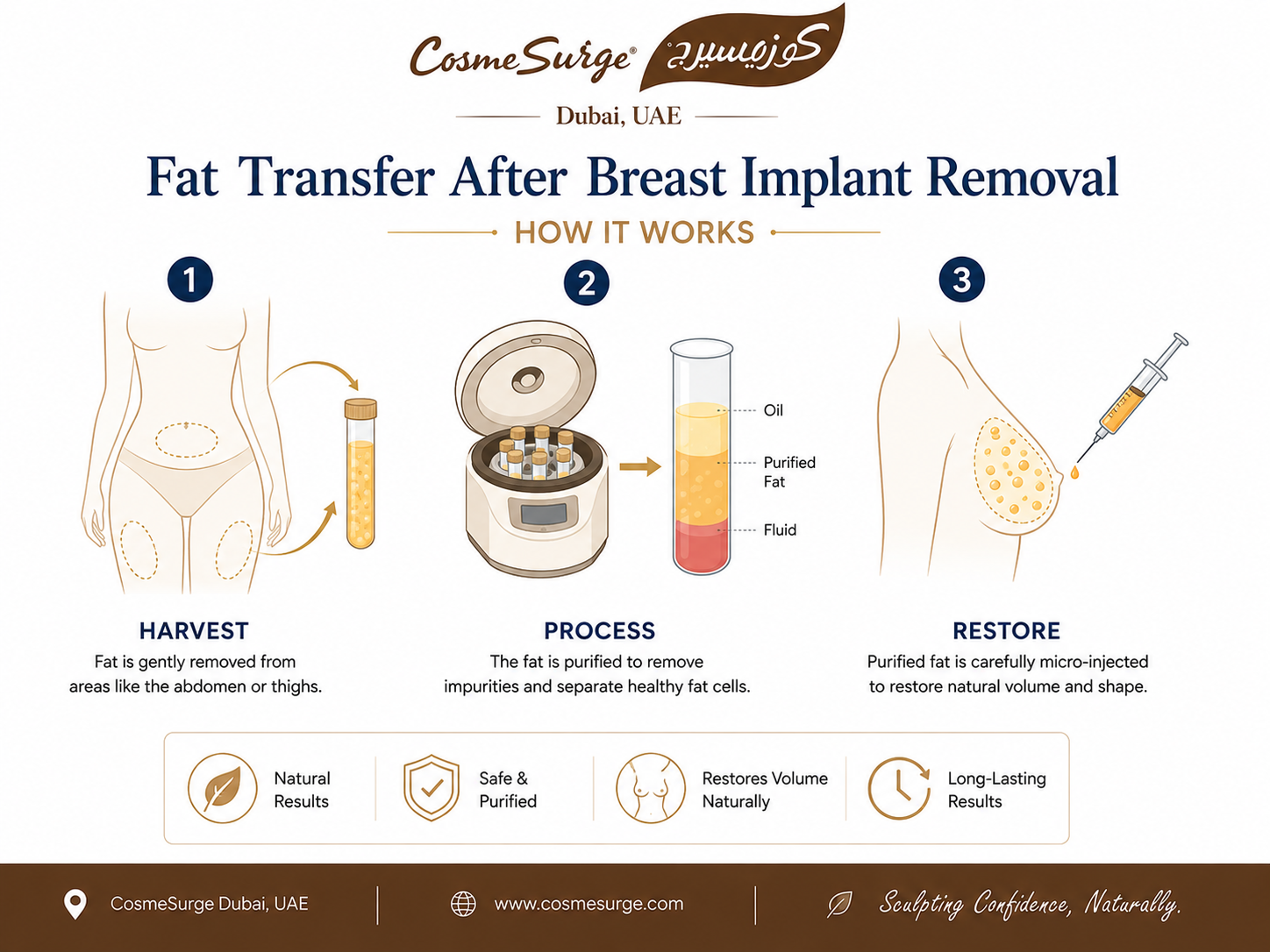
Fat transfer — also called fat grafting or lipofilling — involves removing fat from one area of the body (commonly the abdomen, flanks, or thighs) through liposuction, processing it, and re-injecting it into the breast. It is a fully natural approach that uses the body’s own tissue.
Fat transfer does not replace the volume of a full breast implant. A single session typically adds one to two cup sizes at most, and some of the transferred fat is naturally reabsorbed by the body over the following months. For women who want a modest, natural-looking restoration of volume after explant — without returning to implants — it can be an excellent option.
Fat transfer is particularly well suited to:
Women with adequate donor fat available in other areas of the body
Those who want a soft, natural-looking result rather than a dramatic size increase
Patients combining fat transfer with mastopexy for both shape and volume improvement
Women who are specifically looking to avoid implants going forward
The procedure is typically performed under general anaesthesia and involves a relatively short recovery — usually two to three weeks for most normal activities. Final results are visible at three to six months, once any reabsorption of transferred fat has stabilised.
Breast Implant Removal Alone vs Explant with Lift: Key Differences
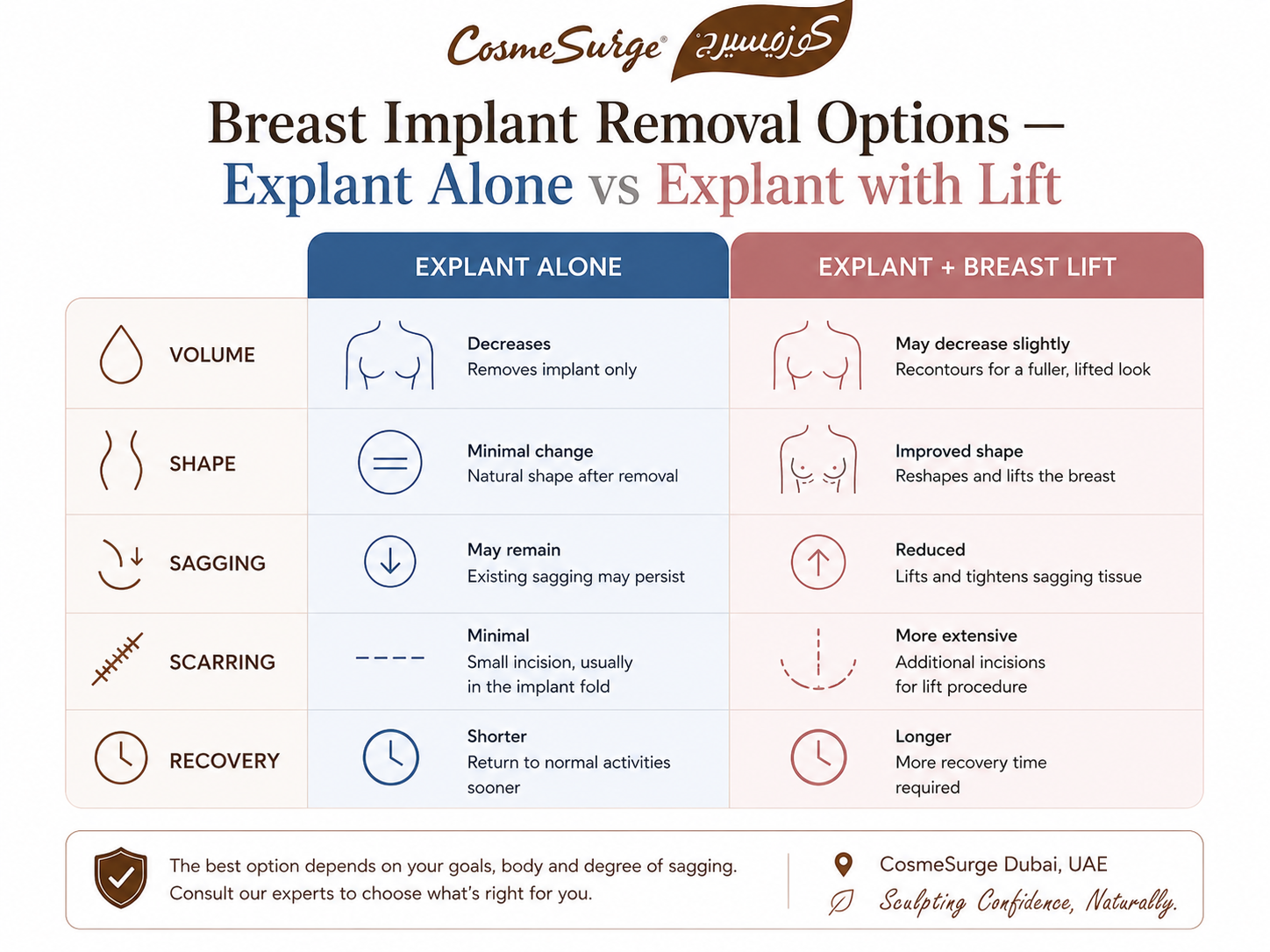
For women weighing up their options after explant surgery, the table below summarises the key differences between proceeding with explant alone and combining the removal with a mastopexy.
Feature | Explant Alone | Explant + Lift (Mastopexy) |
Volume | Depends entirely on natural tissue; may be minimal | Improved projection and distribution of remaining tissue |
Shape | May appear flat, saggy, or deflated without additional reshaping | Breast mound reshaped and repositioned for improved contour |
Sagging correction | None — existing ptosis remains and may worsen without implant support | Yes — excess skin removed; nipple and areola repositioned |
Scarring | Minimal — small scar near original implant incision site | More extensive — around areola, vertical, and/or anchor pattern |
Recovery | Shorter — typically 1 to 2 weeks off work | Longer — 2 to 4 weeks off work; compression garment for 4–6 weeks |
Best suited for | Women with good skin elasticity and modest pre-explant ptosis | Women with significant sagging, excess skin, or larger implants removed |
The right approach depends on your individual anatomy, the degree of skin laxity, the size of the implants removed, and your personal goals. A consultation with an experienced surgeon is the most reliable way to determine which option — or combination of options — is most appropriate for you.
Emotional Recovery After Breast Implant Removal
The physical changes that follow explant surgery are well documented. The emotional journey is discussed far less often — but for many women, it is equally significant.
It is common to feel a complicated mix of emotions in the weeks following surgery: relief if the removal was driven by health concerns, grief for the body shape you had grown accustomed to, anxiety about how you will feel about your appearance once healing is complete, and uncertainty about what “normal” will look and feel like going forward.
These feelings are valid — and they do not mean the decision was wrong. Many women who choose explant surgery for health reasons experience a period of genuine emotional adjustment before arriving at a sense of peace and acceptance. This process takes time, and expecting yourself to feel settled within the first few weeks is unrealistic.
Body image is closely tied to identity and self-confidence. When that image changes significantly and rapidly, it takes time for our perception of ourselves to catch up with the physical reality. Giving yourself that time — without judgment — is an important part of recovery.
If feelings of anxiety, low mood, or distress persist beyond the initial recovery period, speaking with a counsellor or psychologist who has experience working with body image concerns can be genuinely helpful. You do not need to navigate this transition alone.
When Should You See a Plastic Surgeon After Explant Surgery?
If you had your implants removed elsewhere and have concerns about the outcome, or if you are approaching the end of the natural recovery period and are unhappy with the result, a consultation with a specialist is the right next step.
Consider seeking a surgical opinion if you experience:
Persistent asymmetry that has not improved after six months
Excess skin that has not contracted during the recovery period
Significant nipple descent or malpositioning
A shape or volume outcome that is affecting your daily life, confidence, or wellbeing
Desire to explore fat transfer, mastopexy, or a new augmentation
There is no obligation to pursue further surgery — a consultation is an opportunity to understand your options and make an informed decision. Many women leave a post-explant consultation feeling more confident simply from having a clear picture of what is achievable.
Myth vs Fact: Breast Implant Removal and Breast Shape
Myth: Breasts stay permanently flat after implant removal.
Fact: Many women experience a meaningful improvement in breast shape through natural tissue fluffing, skin contraction, and fat redistribution over the 6 to 12 months following surgery. The degree of improvement varies, but flatness is often a temporary rather than a permanent state.
Myth: Everyone needs a breast lift after explant surgery.
Fact: A breast lift is not necessary for all women after implant removal. Those with good skin elasticity, smaller implants, and limited pre-existing sagging often achieve a satisfactory natural result from explant alone. The need for a lift is assessed case by case, based on anatomy and personal goals.
Myth: Exercise can fully restore lost breast volume.
Fact: Exercise strengthens the underlying pectoral muscles, which can improve chest contour and provide a firmer base for the remaining breast tissue. It cannot replace breast volume, reverse skin laxity, or correct sagging. Where volume restoration is the goal, fat transfer or further surgical options are the appropriate route.
Myth: Fat transfer gives the same result as a new implant.
Fact: Fat transfer and implants are very different tools. Fat grafting offers a modest, natural-looking volume increase using the body’s own tissue — typically one to two cup sizes. Implants provide a more dramatic, predictable volume change. Fat transfer is ideal for women who want natural enhancement without returning to implants.
Conclusion
Feeling flat after breast implant removal is one of the most common experiences women report following explant surgery — and it is one of the most understandable. The breasts have been shaped around an implant for months or years; removing that volume changes the entire landscape of the chest almost overnight.
The reassuring reality is that for many women, this flatness is temporary. The natural process of tissue fluffing, skin contraction, and fat redistribution means that the first weeks after surgery are rarely the final picture. Patience, good self-care, and realistic expectations are the foundation of a healthy recovery.
For women who want additional volume, improved shape, or correction of sagging after the natural recovery process is complete, breast lift surgery and fat transfer offer safe, well-established options that can meaningfully improve both appearance and confidence. These procedures are not about undoing the decision to have implants removed — they are about supporting the body in its next chapter.
At CosmeSurge, experienced breast specialists provide individualised treatment plans following explant surgery — from supportive guidance through the natural recovery process to advanced procedures that help women achieve natural-looking, confidence-restoring results. The approach is always compassionate, patient-centred, and clinically grounded.
If you are concerned about breast shape after explant surgery — or simply want to understand your options — consulting the experts at CosmeSurge is a positive and practical step toward feeling informed and in control of what comes next.
Frequently Asked Questions About Flat After Breast Implant
Here are some answers to the specific questions we often hear but didn’t cover in detail above.
Yes — looking flat after breast implant removal is completely normal and expected. The implants provided volume, shape, and projection that is no longer present after surgery. In the early recovery period, swelling and compression garments can make the result look even flatter temporarily. Over the following months, natural tissue fluffing and skin contraction typically improve the appearance significantly.
The fluffing process — natural tissue settling and skin contraction — typically begins within the first few weeks and continues for up to 12 months after explant surgery. Most women see the most noticeable improvement between months two and six. The degree of fluffing depends on skin elasticity, implant size, age, and the amount of natural breast tissue present.
Many women are happy with their natural breast appearance after the recovery process is complete, though the breasts will not return to their exact pre-augmentation shape. How the breasts look depends on skin elasticity, implant size, duration of placement, and natural tissue quality. Women who want additional improvement after natural recovery may benefit from a breast lift or fat transfer procedure.
Breasts appear deflated after implant removal because the volume and support provided by the implant is no longer present. The skin that was stretched around the implant has not yet contracted, leaving a loose envelope with less internal volume to fill it. This is a normal early finding. Skin contraction and tissue redistribution during recovery gradually improve the appearance in most patients.
Fluffing after explant refers to the natural process of tissue settling, skin contracting, and fat redistributing that occurs as the body adapts to the removal of breast implants. It is a gradual process that unfolds over weeks and months, and it can meaningfully improve breast shape and softness during the recovery period. The degree of fluffing varies considerably between individuals based on anatomy and skin elasticity.
Yes — fat transfer (fat grafting) can restore modest volume after breast implant removal using the body’s own fat cells harvested from other areas such as the abdomen or thighs. Results are natural-looking and soft. Fat transfer typically increases volume by one to two cup sizes, with some reabsorption expected in the months following the procedure. It is an excellent option for women seeking natural enhancement without returning to implants.
Not everyone needs a breast lift after explant surgery. The need depends on the degree of skin laxity, nipple position, implant size, and personal goals. Women with good skin elasticity and smaller implants may achieve a satisfactory result from explant alone. Women with significant sagging, excess skin, or larger implants removed are more likely to benefit from mastopexy. A post-recovery consultation with a specialist provides the clearest guidance.
Exercise — particularly chest strengthening through pressing and push-up movements — can improve the firmness and definition of the chest wall, which provides a better foundation for the overlying breast tissue. This can modestly improve breast contour and projection. However, exercise cannot restore breast volume, correct skin laxity, or address sagging. It is a useful complement to recovery but not a replacement for surgical correction when significant shape change is desired.
The most common side effects of breast implant removal include temporary flatness, loose or excess skin, wrinkling, sagging, loss of upper pole fullness, and temporary asymmetry. Most of these changes improve during the fluffing and recovery process over 6 to 12 months. Persistent side effects — particularly sagging, skin laxity, or significant volume loss — may be addressed with breast lift surgery or fat transfer if desired.
Most women return to desk-based work within one to two weeks of explant surgery. Physical activity is gradually reintroduced over four to six weeks. The visible aspects of recovery — swelling, bruising, and early shape changes — resolve within six to twelve weeks. The natural fluffing and tissue settling process continues for up to twelve months, after which the final outcome becomes clear.
Yes — sagging is a common finding after breast implant removal, particularly in women who had larger implants, wore them for longer periods, or had pre-existing breast ptosis that the implants were masking. The degree of sagging depends on skin elasticity, implant size and duration, and pregnancy history. For women who are concerned about post-explant sagging, mastopexy (breast lift surgery) offers an effective and lasting correction.
Women who are unhappy with their breast appearance after explant surgery have several options: breast lift surgery (mastopexy) to address sagging and excess skin; fat transfer to restore modest natural volume; or a combination of both. In some cases, a new breast augmentation with different-sized implants may be appropriate. The right path depends on individual anatomy and goals, and a consultation with an experienced specialist is the best starting point.
Medical Disclaimer & Review
Content on the CosmeSurge website is for informational and educational purposes only and does not replace professional medical advice, diagnosis, or treatment. Always consult a qualified healthcare professional for medical concerns and never delay seeking advice based on this content. In emergencies, contact your doctor or local emergency services immediately. All website content is reviewed by qualified medical professionals to ensure accuracy and alignment with current evidence-based practices.
Related Posts

Puffy Nipples: Causes, Symptoms, and Treatment Options for Men and...Read More
Flat After Breast Implant Removal: Is It Normal and What...Read More

How to Get Rid of Gyno: Causes, Natural Remedies, Exercises,...Read More
Gaunt Face, Hollow Cheeks and Sunken Cheeks: Treatment Key Takeaways...Read More