
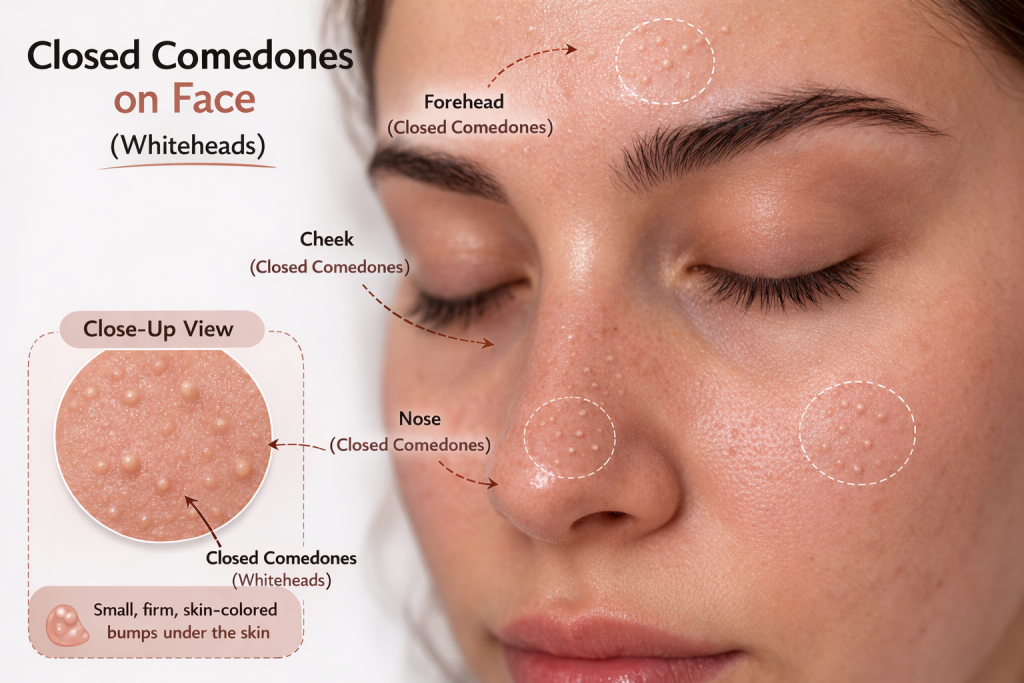
It is a common morning ritual: you lean into the bathroom mirror, perhaps under a specific angle of light, and notice a cluster of tiny, persistent bumps that seem to have no intention of leaving. They don’t hurt, they aren’t red, and you cannot “pop” them like a typical pimple. These are closed comedones, and while they can appear anywhere on the face, their location often tells a very specific story about what is happening with your skin, your habits, or even your hormones. Whether you are dealing with closed comedones forehead clusters or stubborn bumps along your jawline, understanding the localized “why” is the first step toward finding a solution that actually works.
In the clinical environment at CosmeSurge Hospital, Dubai, UAE, we often see patients who are frustrated by the uneven texture of their skin. In a climate like ours—where heat, dust, and high humidity are part of daily life—the pores are under constant pressure. We tend to see patterns: the forehead reacts to hair products, the chin responds to hormones, and the cheeks often suffer from heavy cosmetics or environmental pollutants. Mapping these bumps isn’t just about aesthetics; it is about diagnostic clarity.
The Anatomy of a Clog
Before we look at specific locations, we have to understand the mechanism. A closed comedone is essentially a microscopic “plug” of dead skin cells and sebum (oil) trapped inside a hair follicle. Unlike a blackhead, which is open to the air and oxidizes, a closed comedone is sealed by a thin layer of skin. This “seal” is why they remain flesh-colored and why they are so resistant to traditional face washes.
The Forehead: A Common Battleground
When patients present with closed comedones forehead issues, the culprit is often external. The forehead has a high concentration of sebaceous glands, making it naturally oilier. However, it is also the area most frequently in contact with hair products.
Pomade Acne: Shampoos, conditioners, and styling oils often contain heavy silicones or oils. When you sweat, these products migrate down to the hairline and forehead, physically blocking the pores.
Friction and Sweat: Headbands, hats, or even fringes (bangs) can trap sweat and bacteria against the skin, leading to a localized breakout of comedones.
Digestive Link? While traditional Chinese medicine often links the forehead to the digestive system, from a modern dermatological perspective, we look more closely at high-glycemic diets that may trigger insulin spikes, leading to increased oil production in this specific “T-zone” area.
The Chin and Jawline: The Hormonal Connection
If your bumps are concentrated on the lower third of your face, particularly the chin and jawline, the cause is often internal. This area is highly sensitive to hormonal fluctuations.
Androgen Sensitivity: Hormones like testosterone (present in everyone) signal the oil glands in the chin area to produce more sebum. This sebum is often “stickier” than usual, making it harder for the pore to clear itself.
“Maskne” and Friction: Since 2020, we have seen a massive spike in jawline comedones caused by face masks. The humid micro-environment created by breathing into a mask softens the skin’s outer layer, making it easier for debris to get pushed into the follicles.
The Cheeks: Cosmetics and Environment
Closed comedones on cheeks often point toward the products we use. Because the skin on the cheeks is slightly thicker than the T-zone, it can be more prone to clogs from heavy, “occlusive” ingredients.
Comedogenic Makeup: Long-wear foundations or heavy blushes can settle into the pores. If these aren’t thoroughly removed, they form the “glue” for a comedone.
Phone Screens and Pillowcases: We often forget how much bacteria and old oil sit on the surfaces that touch our cheeks daily.
Environmental Dust: In the UAE, fine sand and dust can settle on the skin’s surface. When mixed with sweat, this creates a “sludge” that easily blocks pores on the wider surface of the cheeks.
When to Seek Professional Evaluation
Most of us try to handle these bumps with over-the-counter scrubs, but often, that just irritates the surface without reaching the root. If you have been struggling with closed comedones forehead clusters or persistent jawline bumps for more than two months without improvement, it is time for a clinical perspective.
At CosmeSurge Hospital, Dubai, UAE, the diagnostic process involves more than just a quick glance. We look at the “comedogenic load” of your current routine. We assess whether the bumps are truly comedones or perhaps milia (keratin cysts) or even a condition called Malassezia folliculitis (fungal acne), which looks nearly identical but requires a completely different treatment.
Clinical Treatment Pathways
Once we identify the cause, the treatment is tailored to the location and the skin’s sensitivity.
1. Topical Retinoids
Regardless of the location, retinoids remain the gold standard. They work by increasing cell turnover—telling the skin to shed those “sticky” cells before they can form a plug.
For the Forehead: Since forehead skin is generally tougher, it can often handle slightly stronger concentrations of Adapalene or Tretinoin.
For the Chin/Jawline: We often combine retinoids with anti-inflammatory agents to manage the hormonal sensitivity of the area.
2. Chemical Exfoliation (Salicylic and Glycolic Acids)
Salicylic acid is oil-soluble, making it perfect for the oily T-zone. It travels into the pore to dissolve the sebum plug. Glycolic acid, on the other hand, works on the surface to remove the “seal” that keeps the comedone closed.
3. Professional Extractions
For deep-seated closed comedones forehead or cheek clogs, sometimes topicals aren’t enough. Professional extraction involves using sterile tools to apply precise pressure. This should never be done at home. A specialist at CosmeSurge Hospital, Dubai, UAE, can clear the pore without rupturing the follicle wall, which is what causes scarring when people “pick” at their skin.

Prevention: A Zonal Approach
To keep your skin smooth, you need a strategy that addresses the specific stressors of each area.
Hair Hygiene: If you have forehead bumps, try washing your face after you have rinsed out your hair conditioner in the shower. This removes any lingering hair product from your skin.
The Double Cleanse: Especially for the cheeks and jawline, the first cleanse should remove makeup and SPF, and the second should actually clean the skin.
Non-Comedogenic Sunscreen: In our climate, sunscreen is mandatory, but it must be a “fluid” or “gel” texture that won’t contribute to further congestion.
Hormonal Awareness: Tracking your cycle or discussing hormonal health with a doctor can help you anticipate and mitigate the chin/jawline flares.
Closing Thoughts: Understanding Your Skin’s Signals
Textured skin can often feel frustrating, especially when bumps seem to shift from the forehead to the jawline without warning. But it is important to remember that your skin is a living organ that constantly responds to internal and external factors. When you notice closed comedones on the forehead or clustered along the jawline, you are not just seeing a problem — you are gathering clues about what your skin needs.
Sometimes the solution may be as simple as adjusting your hair care products or avoiding heavy styling creams that clog pores near the hairline. In other cases, hormonal fluctuations, stress, or improper skincare layering may be contributing factors. Paying attention to these patterns allows you to make smarter, more targeted changes instead of randomly switching products.
For persistent or widespread congestion, professional care can offer structured and effective solutions. At CosmeSurge Hospital, dermatology specialists provide customized treatment plans, including medical-grade chemical peels and evidence-based skincare guidance tailored to your skin type and concerns.
No matter which path you choose — adjusting your home routine or opting for clinical treatments — the ultimate goal remains the same: restoring and protecting a healthy, balanced skin barrier. Stay patient, remain consistent, and seek professional advice when needed. With the right approach, smoother, clearer skin is absolutely achievable.

Frequently Asked Questions (FAQs)
The forehead is part of the T-zone and has the most active oil glands. It’s also the area most affected by hair products and sweat, making it the “path of least resistance” for clogs to form.
Yes. Friction combined with trapped sweat creates a perfect environment for pores to become blocked. If you wear hats, ensure they are made of breathable fabrics and wash them frequently.
No, but they look very similar. Fungal acne (folliculitis) is an overgrowth of yeast in the hair follicle. It is usually itchier and the bumps are more uniform in size than typical comedones.
This is due to a drop in estrogen and a relative increase in progesterone and androgens, which stimulates oil production specifically in the lower face.
Physical scrubs often just irritate the surface and can cause micro-tears in the skin. Chemical exfoliants like Salicylic acid are much safer and more effective at reaching the actual clog.
Humidity makes sebum more fluid, but it also causes dust and pollutants to stick to the skin. Without proper cleansing, this mixture easily blocks pores.
Typically, the slight redness from a professional extraction at a facility like CosmeSurge Hospital, Dubai, UAE, fades within 24 to 48 hours.
Unfortunately, no. Because comedones are deep-seated, it usually takes 8 to 12 weeks of consistent treatment to see a significant change in skin texture.
High-sugar foods and dairy have been linked to increased oil production in some people, which can certainly worsen clogs in the oily T-zone.
Because they are “closed,” they are protected from the acne bacteria that live on the surface. They only become “real” (inflammatory) pimples if the follicle wall ruptures or bacteria get trapped inside.
The skin on the jawline can be sensitive. We usually recommend a “buffered” approach—applying moisturizer first, then the retinoid—to reduce irritation while still clearing the pores.
There is no medical evidence that detox teas clear pores. Real “detoxing” is done by your liver and kidneys. Skin clearing requires topical management of the hair follicle.
In medical terms, they are the same thing. A “whitehead” is simply the common name for a closed comedone.
These might be sebaceous filaments—natural channels for oil—rather than clogs. A specialist can help you tell the difference so you don’t over-treat a normal skin function.
Stress increases cortisol, which triggers oil production. More oil means more “glue” to trap dead skin cells, leading to new clogs.
Medical Disclaimer & Review
This content is for educational purposes only and does not replace professional medical advice. Always consult a qualified healthcare provider for diagnosis and treatment.
Medically reviewed by a qualified specialist at CosmeSurge Hospital, Dubai, UAE.


