

When a woman first notices the gradual shift in the contour of her chest, the emotional response can be complex. For some, it is a quiet acknowledgment of the passage of time; for others, it feels like a sudden departure from their sense of self after the transformative experiences of pregnancy or significant weight loss. While the internet is filled with anecdotal advice on exercises or topical oils, those seeking a clinical, lasting change eventually look toward professional saggy breast treatment. Navigating the medical options for breast restoration—technically referred to as ptosis correction—requires a blend of anatomical understanding, realistic expectations, and an appreciation for the surgical and non-surgical technologies available today.
In a clinical setting, such as a consultation at CosmeSurge Hospital, Dubai, UAE, the conversation isn’t about chasing an impossible standard of perfection. Instead, it is about restoring a sense of proportion and comfort. Because breast tissue is fundamentally a combination of fat, glands, and skin—unsupported by internal muscle—the “treatment” of sagging is essentially a mechanical challenge. It involves repositioning the “internal brassiere” of the breast and managing the excess skin envelope that has been stretched beyond its elastic limit.
The Biochemistry of the "Skin Envelope": Why Elasticity Fails
To understand how any saggy breast treatment works, we have to look at the microscopic level. The skin of the breast is supported by a matrix of two primary proteins: collagen and elastin.
Collagen provides the strength and “tethering” of the skin to the underlying structures.
Elastin allows the skin to “snap back” after it has been stretched.
In our youth, this matrix is dense and resilient. However, life events like pregnancy or weight fluctuations act like a mechanical “overload” on these fibers. When the skin is stretched too far for too long—a state known as reaching the “plastic deformation point”—the elastin fibers snap or lose their recoil. At this stage, the skin becomes “crepey” and thin. In the UAE, this process is often accelerated by high UV exposure on the décolletage, which leads to “solar elastosis,” a condition where the sun’s rays effectively “cook” the elastin fibers, making the skin less able to support the weight of the breast. Clinical treatments must address this biological degradation to be successful.
Clinical Grading: Defining the Degree of Ptosis
Before a specialist can recommend a specific saggy breast treatment, they must accurately grade the level of descent. This isn’t just about how the breast looks; it’s a measurement of the nipple’s position relative to the inframammary fold (the crease where the breast meets the chest wall).
Grade I (Mild): The nipple is at the level of the crease.
Grade II (Moderate): The nipple has fallen below the crease but remains above the lowest part of the breast tissue.
Grade III (Advanced): The nipple is at the lowest point of the breast and points downward.
Pseudoptosis: This is a common finding after weight loss where the breast tissue sits low, but the nipple is still in a high, youthful position.
Identifying these grades is the first step in the patient journey. A Grade I concern might be managed with non-invasive skin tightening, whereas a Grade III presentation almost always requires a surgical mastopexy to achieve a functional and aesthetic lift.
Non-Surgical and Minimally Invasive Options for Saggy Breast
For patients with very mild sagging or those who are not candidates for surgery, non-surgical technologies can provide a modest improvement in skin tension. These treatments do not relocate the nipple, but they can improve the “snap-back” of the skin.
1. Radiofrequency (RF) and Ultrasound Tightening
Devices that utilize Radiofrequency or High-Intensity Focused Ultrasound (HIFU) deliver thermal energy deep into the dermis. This heat causes existing collagen fibers to contract and stimulates the production of new elastin. While the lift is subtle, it can be an effective saggy breast treatment for women noticing early-stage “crepe-like” skin texture on the upper poles of the breast.
2. Laser Skin Resurfacing
Lasers target the superficial and mid-dermal layers. By inducing controlled micro-injuries, the body’s healing response creates a thicker, more resilient skin envelope. This is often used as a supportive treatment alongside other modalities to improve the overall quality of the skin.
3. Thread Lifts (Absorbable Sutures)
Some clinics offer a “thread lift” for the breasts. This involves placing absorbable, barbed sutures under the skin to physically lift the tissue. However, medical professionals often advise caution here; because breast tissue is heavy, the longevity of these threads can be quite limited compared to surgical alternatives.
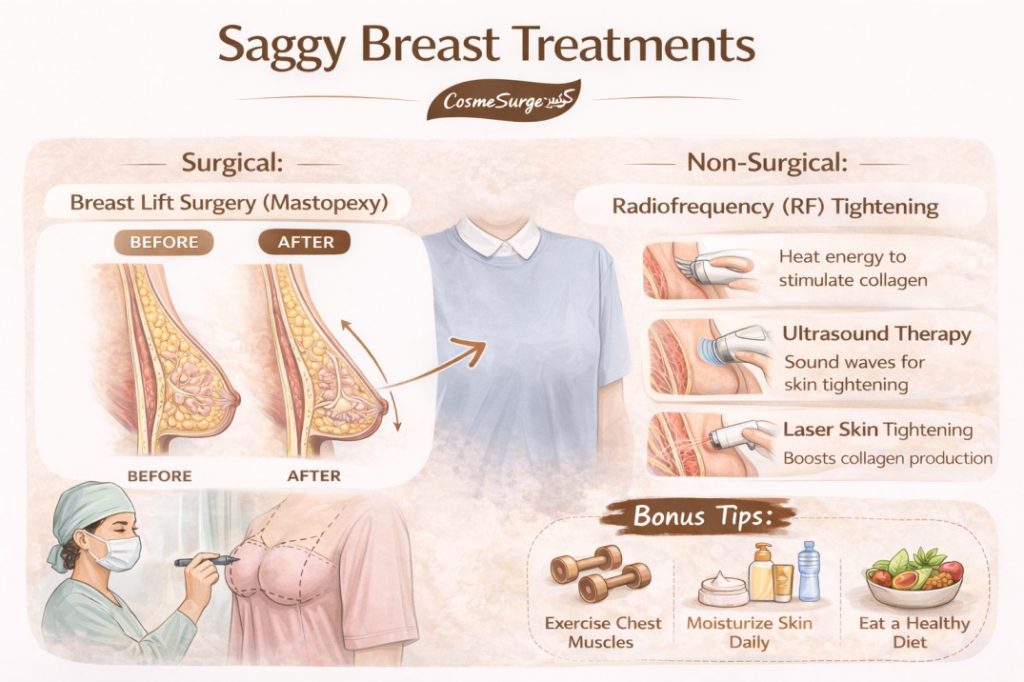
Surgical Mastery: The Breast Lift (Mastopexy) for Saggy Breast
When we discuss a definitive saggy breast treatment, we are usually talking about a mastopexy. This is a surgical procedure designed to raise the breasts by removing excess skin and tightening the surrounding tissue to reshape and support the new breast contour.
The Incision Patterns
The choice of incision depends entirely on the degree of ptosis.
Periareolar (Donut): A single incision around the edge of the areola. This is ideal for mild sagging.
Vertical (Lollipop): An incision around the areola and one running down to the breast crease. This allows for significant lifting and reshaping.
Inverted-T (Anchor): This involves three incisions and is used for advanced cases where a large amount of skin needs to be removed.
At a facility like CosmeSurge Hospital, Dubai, UAE, the surgical plan is highly individualized. During the planning phase, the surgeon must account for the patient’s future plans—such as pregnancy—as further volume changes can affect the longevity of the surgical result.
The Patient Journey: Diagnosis and Consultation
Seeking professional help often feels like a hurdle, but the process is designed to be supportive. At CosmeSurge Hospital, Dubai, UAE, the consultation is a detailed diagnostic event. It begins with a review of the patient’s medical history, including any previous breast surgeries or mammograms.
A specialist will perform a physical examination to check skin elasticity and the “pinch test” to evaluate tissue thickness. This is where the patient’s goals are aligned with clinical reality. The surgeon will explain the risks—such as scarring, changes in nipple sensation, or the potential for asymmetry—ensuring the patient is fully informed before making a decision.

Detailed Recovery: The Day-by-Day Experience
Understanding the recovery timeline helps manage expectations and ensures the best results for your saggy breast treatment.
Days 1–3: You will wear a surgical compression bra 24/7. There will be a feeling of “heaviness” and “tightness” in the chest. Pain is typically managed with standard prescribed medication.
Week 1: Most patients can return to light, sedentary work. You will still be restricted from lifting anything heavier than a laptop.
Weeks 2–4: Bruising typically fades. You may start to feel “zings” or sharp, temporary sensations as the nerves in the breast tissue begin to heal. This is completely normal.
Month 3: The “Drop and Fluff.” This is a clinical term for when the initial swelling completely subsides and the breast tissue settles into its final, natural-looking position.
Choosing the Right Path: A Diagnostic Checklist
Before your appointment, you can self-evaluate to help guide your discussion with a specialist:
The Nipple Position: Is your nipple above, at, or below the crease of your breast?
The Pinch Test: When you pinch the skin on the upper part of your breast, does it snap back immediately or stay tented for a second?
The Volume Question: Are you happy with the size of your breasts and just want them higher, or do they feel “empty” at the top? (This helps decide between a lift and an augmentation-mastopexy).
Closing Thoughts: Restoring Confidence Through Expertise
Choosing to pursue saggy breast treatment is a deeply personal decision that exists at the intersection of health and self-image. It is a journey that moves from the initial recognition of change to the structured, clinical path of restoration. While the world of aesthetic medicine offers many options, the most successful outcomes are those built on a foundation of honesty between the patient and the specialist.
Whether you find that a non-invasive tightening procedure provides the subtle refresh you need, or you decide that a surgical lift is the right way to restore your silhouette, the goal is to feel comfortable and “at home” in your body. By focusing on evidence-based treatments and professional aftercare, you can navigate the changes brought by time and life with grace. At CosmeSurge Hospital, Dubai, UAE, the clinical team is dedicated to providing that clarity, ensuring that your path toward rejuvenation is as safe as it is transformative.
Frequently Asked Questions (FAQs)
Here are some answers to the specific questions we often hear but didn’t cover in detail above.
For mild cases (Grade I), non-surgical treatments like Radiofrequency can help by tightening the skin. However, if the nipple has descended significantly, surgery is generally the only way to physically relocate the tissue and achieve a visible lift.
While the results are considered long-lasting, they are not immune to the effects of aging, gravity, and future weight fluctuations. Most women enjoy their results for 10 to 15 years, provided they maintain a stable weight and wear supportive bras.
In many cases, breastfeeding is still possible after a mastopexy, especially with techniques that keep the nipple attached to its original blood supply and milk ducts. However, it is a risk that should be discussed with your surgeon during the planning stage.
A breast lift (mastopexy) removes skin and moves the nipple higher. An implant (augmentation) adds volume but does not necessarily fix significant sagging. Many patients require both to achieve their desired outcome.
Initially, scars appear red or pink. Over 12 to 18 months, they typically fade to thin, white lines. Surgeons at CosmeSurge Hospital, Dubai, UAE, work to place incisions where they are hidden by a bra or bikini top.
Most patients can return to light desk work within a week. However, you should avoid heavy lifting and vigorous exercise for at least 6 weeks to ensure internal healing.
Fat grafting can be used to add volume, which may slightly improve the appearance of very mild sagging. However, it does not address the excess skin; if there is a lot of loose skin, adding fat may actually make the sagging look worse due to the added weight.
There is no upper age limit, provided the patient is in good health and has realistic expectations. We see patients from their 20s (due to genetics or weight loss) through their 60s and beyond.
When performed by a qualified professional, these treatments are very safe. However, improper use of thermal energy can cause skin burns or hyperpigmentation, which is why clinical settings are preferred.
Pregnancy will likely stretch the skin and ligaments again, potentially undoing the results of your surgery. Most surgeons recommend waiting until you are finished having children before opting for a surgical lift.
Significantly. Smoking reduces blood flow to the skin, which can lead to poor wound healing, increased scarring, and even tissue necrosis. Most surgeons require patients to quit smoking several weeks before and after surgery.
The surgical bra acts as an external scaffold while your internal tissues heal. Without it, the weight of the breast could pull on the fresh incisions and stretch the new shape.
A lift removes the loose skin, but for the quality of the remaining skin, a doctor might suggest complementary treatments like medical-grade skincare or lasers.
No. There is no medication or cream that can physically lift a breast. Be cautious of products making these claims; they are often unregulated and ineffective.
If you find that sagging is causing physical discomfort, such as back pain or skin irritation in the fold, or if it is affecting your psychological well-being, a consultation is a good first step.
It is usually best to reach your target weight and stabilize there for at least six months before surgery. Further significant weight loss after a lift can lead to more sagging.
While keeping the skin hydrated is helpful, there is no clinical proof that Vitamin E oil alone prevents scarring. Medical-grade silicone sheets or gels are the standard recommendation for scar management.
Some surgeons use a biocompatible mesh to help support the breast tissue from the inside. This can be a useful addition for patients with very thin skin who are at high risk of recurrent sagging.
Most surgeons recommend waiting at least two to three weeks before flying, primarily to avoid the risk of blood clots and to ensure you are close to your medical team in case of any concerns.
Modern mastopexy techniques prioritize a natural, teardrop shape. The goal is a breast that looks like yours, just in a higher, more youthful position on the chest.
Medical Disclaimer & Review
Content on the CosmeSurge website is for informational and educational purposes only and does not replace professional medical advice, diagnosis, or treatment. Always consult a qualified healthcare professional for medical concerns and never delay seeking advice based on this content. In emergencies, contact your doctor or local emergency services immediately.
All website content is reviewed by qualified medical professionals to ensure accuracy and alignment with current evidence-based practices.