
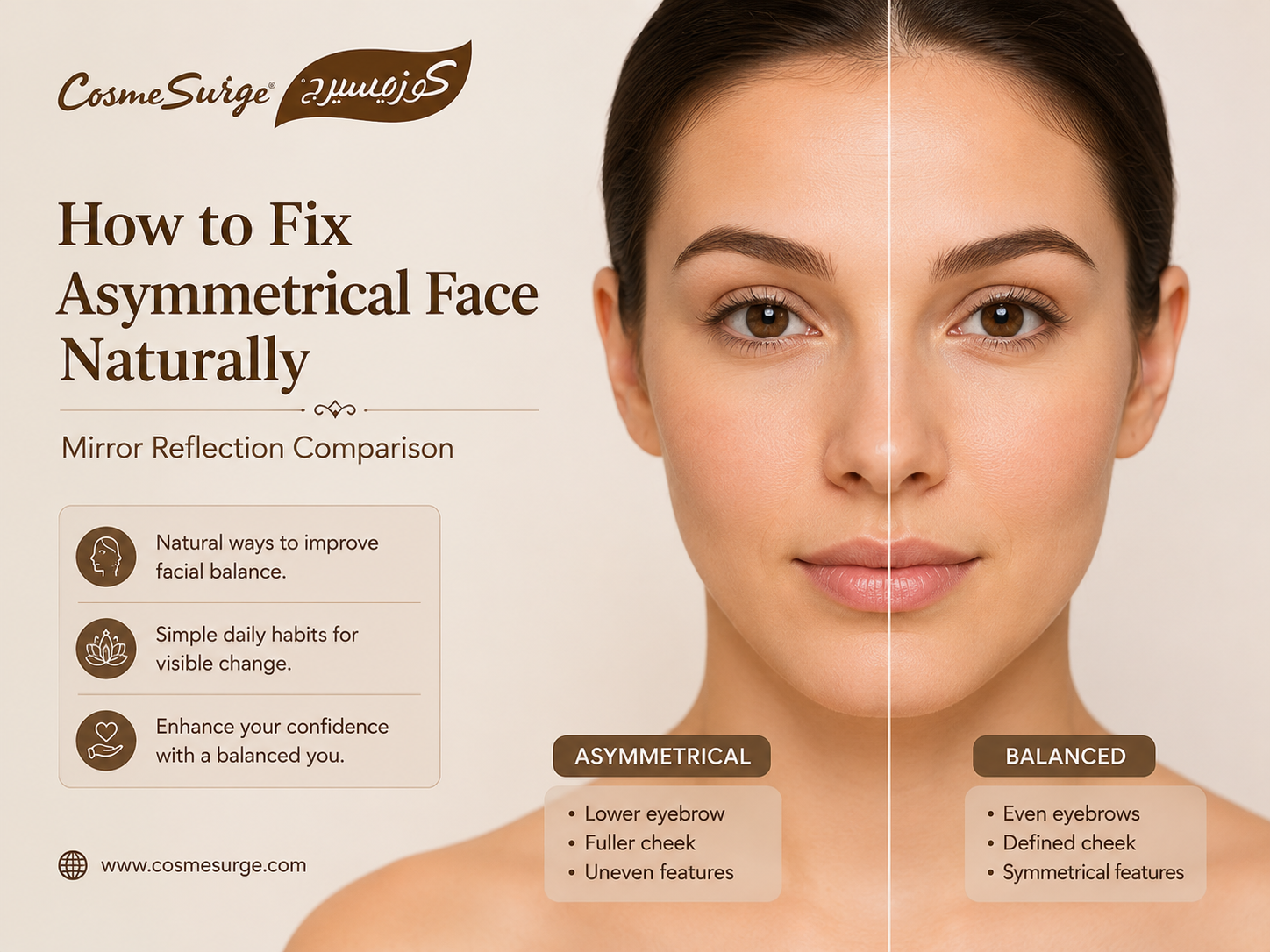
Look closely in the mirror and you may notice one eyebrow sits a little higher, one cheek looks fuller, or your smile pulls slightly to one side. If that sounds familiar, you are completely normal. Not a single human face is perfectly even, and most of the small differences you spot are invisible to everyone else.
Still, when the imbalance starts to bother you, it is natural to ask how to fix asymmetrical face concerns in a safe, sensible way. This guide explains what an uneven face really means, the most common causes of facial asymmetry, which natural habits and exercises may genuinely help, and the clinical treatments available when you want a more noticeable change.
By the end you will have a realistic picture of what can be improved at home, what needs professional input, and when an uneven face is something to get checked by a doctor right away.
Facial symmetry has fascinated artists, scientists, and ordinary people for centuries. We tend to associate balanced features with health and attractiveness, which is partly why so many of us scrutinise our own reflection. But it helps to remember that symmetry is a spectrum, not a switch. Two people can have very different levels of asymmetry and both look completely normal and appealing. The aim of this guide is not to chase an impossible ideal — it is to help you understand your own face and make calm, informed choices about it.
What Is an Asymmetrical Face? Meaning Explained
In simple terms, the asymmetrical face meaning is straightforward: the left and right sides of your face do not match perfectly. So what is asymmetrical face really? It is a face where features such as the eyes, eyebrows, cheeks, nostrils, lips, or jawline differ in size, height, or position from one side to the other.
A certain amount of asymmetry is universal and healthy. Researchers who measure faces consistently find that everyone has some difference between their two sides. In fact, perfectly symmetrical faces can look slightly unnatural or unsettling to us, because they are not what we are used to seeing in real people.
Asymmetry only becomes worth addressing when it is pronounced, when it appears suddenly, or when it affects your confidence. Mild unevenness that has always been there is usually just part of your unique appearance — not a medical problem.
What Is Asymmetry?
Many people ask, “What is asymmetry?” In simple terms, asymmetry means that two sides of something are not exactly identical. Facial asymmetry refers to small differences between the left and right sides of the face. Understanding what is asymmetry and what is asymmetrical face helps set realistic expectations because perfectly balanced facial features do not naturally exist.
In fact, having a slightly asymmetrical face is completely normal and often unnoticeable to others. Small variations in the eyes, cheeks, lips, or jawline are part of what makes every face unique.
What Causes Facial Asymmetry? Common Causes Explained
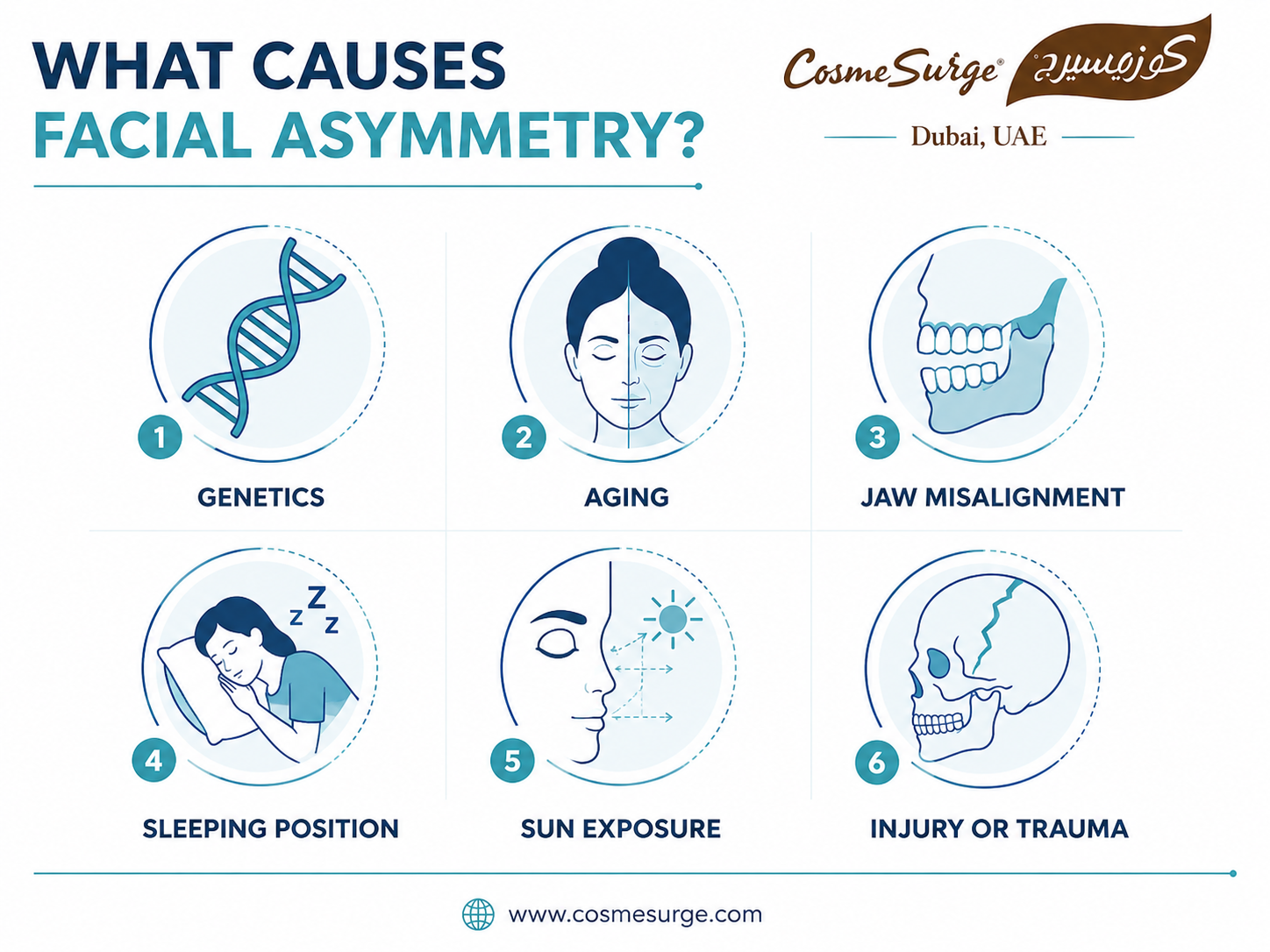
Understanding what causes facial asymmetry is the first step toward fixing it, because the right approach depends entirely on the root cause. The causes of facial asymmetry range from harmless genetics to dental and lifestyle factors. Here are the main asymmetrical face causes to know about.
1. Genetics and natural development
The most common answer to “why is my face asymmetrical” is simply your DNA. The two halves of your face grow at slightly different rates from birth, so inherited bone structure and muscle patterns produce a built-in imbalance. This type is permanent but usually subtle.
2. Aging
As you get older, bone density decreases, collagen drops, and soft tissue and fat pads shift downward — often unevenly. Skin laxity rarely develops at the exact same rate on both sides, which is why facial asymmetry frequently becomes more visible from your forties onward.
3. Dental and jaw issues
Missing teeth, an uneven bite, jaw misalignment, or extensive dental work on one side can pull your jaw and surrounding muscles out of balance. Temporomandibular joint (TMJ) problems and teeth grinding (bruxism) can also enlarge the muscle on one side, making the lower face look lopsided.
4. Sleeping position and posture
Habitually sleeping on the same side, resting your chin on your hand, or carrying a “forward head” posture from screens and phones can place repeated pressure on one side of the face over years. The effect is usually mild, but it is one of the few causes you can directly influence.
5. Sun damage and smoking
Cumulative sun exposure breaks down collagen and elastin. If one side of your face gets more sun — for example, the side facing a car window during a long daily commute — it can age faster. Smoking similarly accelerates skin breakdown and can deepen lines unevenly.
6. Injury and medical conditions
A past fracture, broken nose, or facial trauma can heal in a slightly shifted position. Certain medical conditions — including Bell’s palsy, a history of stroke, or, in childhood, a tight neck muscle (torticollis) — can also cause asymmetry. Sudden, new, or rapidly worsening asymmetry should always be assessed by a doctor (more on this below).
Why Is One Side of My Face Bigger or Fatter?
A very common search is why is one side of my face fatter, or why is one cheek bigger than the other. If you have noticed one cheek looks fuller, several everyday factors could explain it.
Chewing mainly on one side, which builds up the masseter (jaw) muscle on that side.
Teeth grinding or clenching, which enlarges the chewing muscles unevenly.
Sleeping consistently on one side, causing temporary fluid retention or long-term soft-tissue change.
Dental problems such as an abscess, swelling, or an uneven bite.
Natural fat distribution, which is rarely identical on both sides.
If one side of your face has become noticeably bigger quickly, or it is painful, warm, or tender, see a dentist or doctor promptly to rule out infection or swelling. Gradual, painless fullness that has been there a long time is far more likely to be normal variation or muscle balance.
Why Is My Face Lopsided or My Smile Crooked?
Two of the most relatable concerns are “why is my face lopsided” and “why is my smile crooked.” A lopsided face usually comes down to uneven muscle activity, a difference in bone or jaw position, or simple habit — many people unconsciously favour one side when they smile or talk.
A crooked smile specifically is often the result of muscle dominance on one side of the mouth, slight differences in the muscles that lift the lips, or dental and jaw alignment. In most cases it is harmless and even adds character. However, if a crooked smile or facial drooping appears suddenly, treat it as an emergency — it can be a sign of stroke or Bell’s palsy and needs immediate medical attention.
For long-standing, mild unevenness, knowing how to fix lopsided face concerns often starts with the natural habits and exercises covered below, and may progress to professional treatment if you want a stronger result.
People also ask why does my face look lopsided and why is my face so lopsided. In many cases, the answer lies in genetics, aging, chewing habits, muscle imbalance, or sleeping position. While these differences may appear more noticeable in photographs or mirrors, most facial asymmetry is subtle and completely normal.
Why Is My Face Uneven?
Another common concern is “why is my face uneven?” Mild unevenness is usually caused by genetics, aging, jaw imbalance, sleeping habits, posture, and differences in facial muscle activity. In most cases, an uneven face is completely normal and does not indicate a serious health problem.
People searching for how to fix uneven face concerns should understand that treatment depends on the cause. Lifestyle changes, facial exercises, and professional procedures can often improve facial harmony and create a more balanced appearance.
Can an Asymmetrical Face Be Fixed?
So can asymmetrical face be fixed? Yes — to varying degrees depending on the cause. People also ask can you fix asymmetrical face imbalance without surgery, and can facial asymmetry be corrected at all. The honest answer is that results depend on whether the asymmetry is caused by muscle and habit (more responsive to natural methods) or by bone and structure (usually needs clinical treatment).
Mild, muscle- or habit-driven asymmetry: often improved with posture changes, sleep adjustments, and facial exercises over time.
Volume loss or aging-related asymmetry: addressed effectively with non-surgical treatments such as dermal fillers.
Muscle imbalance (for example an over-strong jaw or uneven smile): often softened with muscle-relaxing injections.
Structural or skeletal asymmetry: typically requires orthodontics or, in pronounced cases, corrective surgery.
In short, almost everyone can improve the appearance of an uneven face — but setting realistic expectations matters. The goal of any responsible approach is balance and confidence, not a flawless mirror image, which no real face has.
How to Fix Facial Asymmetry
Many people search for how to fix facial asymmetry or how to fix face asymmetry naturally. The answer depends entirely on the cause.
For mild asymmetry caused by sleeping habits, posture, or muscle imbalance, lifestyle changes and facial exercises may help restore balance over time. More noticeable asymmetry related to aging, volume loss, or jaw structure often responds better to medical treatments.
If you are wondering how to fix facial asymmetry permanently, it is important to understand that permanent correction usually requires orthodontic procedures or surgery when bone structure is involved.
People searching for how to fix face asymmetry should first determine whether the issue is related to muscles, fat distribution, dental problems, or skeletal structure. Once the underlying cause is identified, treatment becomes much more effective.
Why Is One Cheek Bigger Than the Other?
Although some asymmetry is normal, many people worry when one cheek appears fuller than the other.
Common causes include:
Uneven chewing habits.
Teeth grinding and jaw clenching.
Natural fat distribution.
Sleeping predominantly on one side.
Dental infections or bite problems.
Muscle hypertrophy of the jaw muscles.
People searching for one cheek bigger than the other or one side of face bigger than the other should know that these differences are very common and are usually harmless.
If the change happens suddenly or is accompanied by pain, swelling, fever, or numbness, seek medical attention promptly.
Why Is My Face Crooked?
Another frequently searched concern is “why is my face crooked?” Mild crookedness is often caused by asymmetrical muscle activity, genetics, jaw misalignment, or facial habits developed over time.
People looking for how to fix crooked face problems should understand that treatment depends on whether the issue is muscular, dental, or skeletal. Mild cases may improve with exercises and posture correction, while more severe cases may require orthodontic or surgical intervention.
Fix Asymmetrical Face: Setting Realistic Expectations
Many people searching for fix asymmetrical face solutions expect immediate results. However, facial symmetry improves gradually and depends on the underlying cause.
While exercises and healthy habits may help mild imbalances, professional treatments provide faster and more noticeable improvements. The goal is not perfection but achieving a balanced, natural appearance that enhances your confidence.
Similarly, those looking to fix facial asymmetry should focus on long-term improvement rather than chasing perfectly identical facial features, which do not naturally exist.
How to Fix Asymmetrical Face Naturally
If you would rather start at home, here is how to fix asymmetrical face naturally using methods that are safe, free, and backed by common sense. These steps work best for mild, habit-related imbalance and are the foundation of how to improve facial symmetry before considering any clinical option.
Facial symmetry exercises
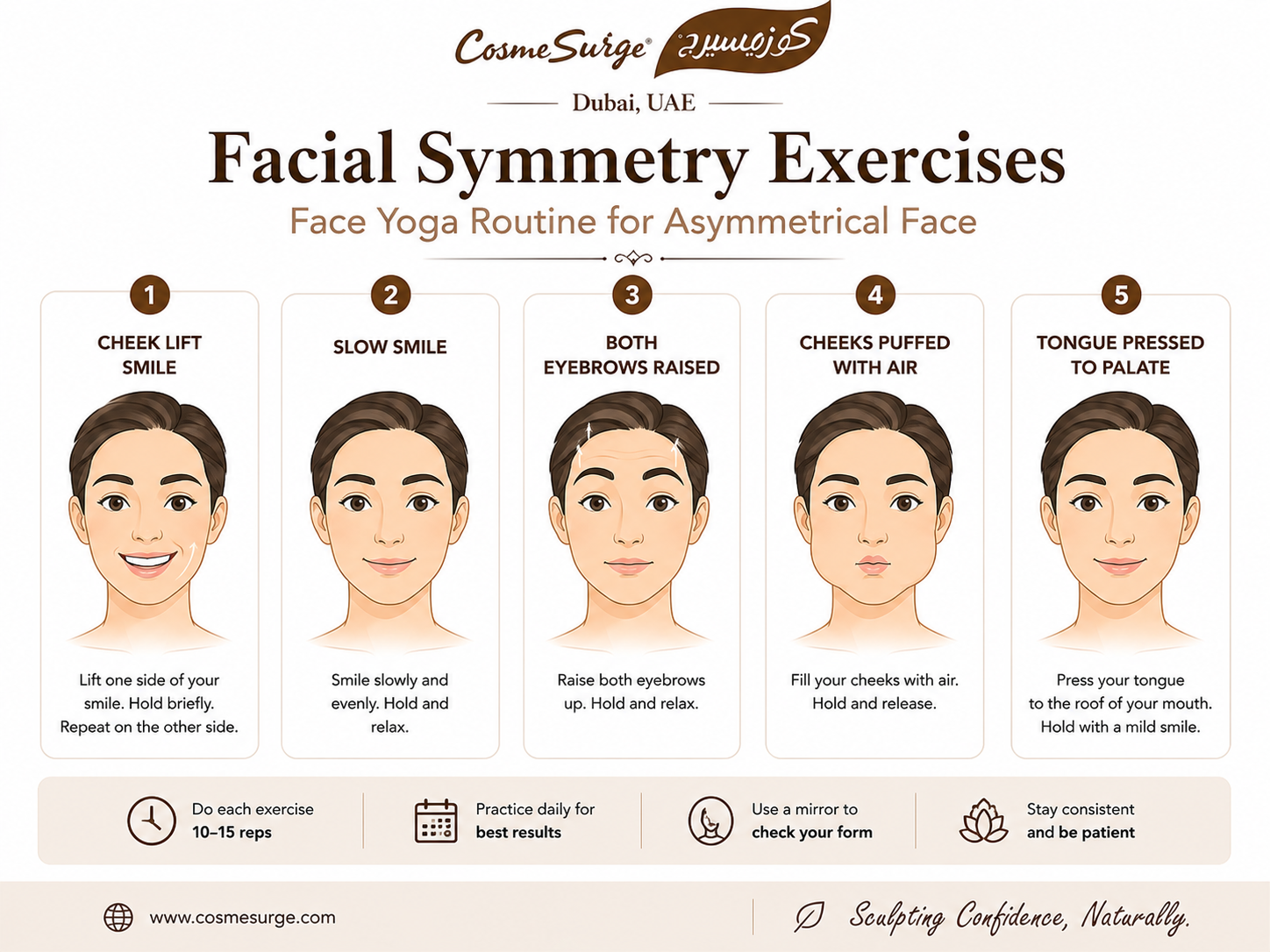
Facial exercises (sometimes called face yoga) aim to tone and balance the muscles you control. Evidence is limited and gradual, but many people find them a low-risk way to explore how to make your face symmetrical looking. Try these consistently for several weeks:
Cheek lifts: smile as wide as you can, hold for five seconds, relax, and repeat 10–15 times, focusing on lifting both sides equally.
Balanced smile practice: in the mirror, smile slowly and consciously even out the weaker side. Repeat 10 times daily.
Eyebrow raises: lift both eyebrows together, hold, and release, encouraging symmetrical forehead movement.
Jaw and cheek puff: fill both cheeks with air, hold for a few seconds, then release. This evens out the chewing muscles.
Tongue press: press your tongue to the roof of your mouth and smile to engage the lower-face muscles evenly.
Always work the weaker or less active side a little more, and avoid overworking an already dominant side. Think of it as gentle, balanced training rather than a quick fix.
Fix your sleeping position
Switching from side-sleeping to sleeping on your back removes prolonged pressure from one side of the face. A supportive pillow and, if needed, a silk pillowcase to reduce friction can help. This is one of the simplest changes when you want to know how to fix asymmetrical face habits at their source.
People frequently ask whether sleeping position affects facial symmetry. While side sleeping alone does not cause severe asymmetry, years of repeated pressure may contribute to mild differences between the two sides of the face.
Improve your posture
A forward-head posture and constantly looking down at devices pull the neck and jaw out of alignment, which over time affects the face. Keep screens at eye level, strengthen your neck and upper back, and avoid resting your chin in your hand. Better posture supports a more balanced face and jawline.
Break uneven daily habits
Chew food evenly on both sides of your mouth.
Avoid leaning your face on your hand while working or studying.
Carry bags evenly or alternate shoulders.
Address teeth grinding — a night guard from your dentist can prevent muscle overdevelopment on one side.
Protect and care for your skin
Daily broad-spectrum sunscreen prevents uneven sun damage, especially on the side exposed during commutes. Quitting smoking, staying hydrated, and a consistent skincare routine keep both sides aging at a similar pace, supporting a naturally symmetrical face for longer.
These natural strategies answer how to make face symmetrical questions for mild cases and are well worth several months of consistency. If you have tried them and still want a clearer change, professional treatment is the next step.
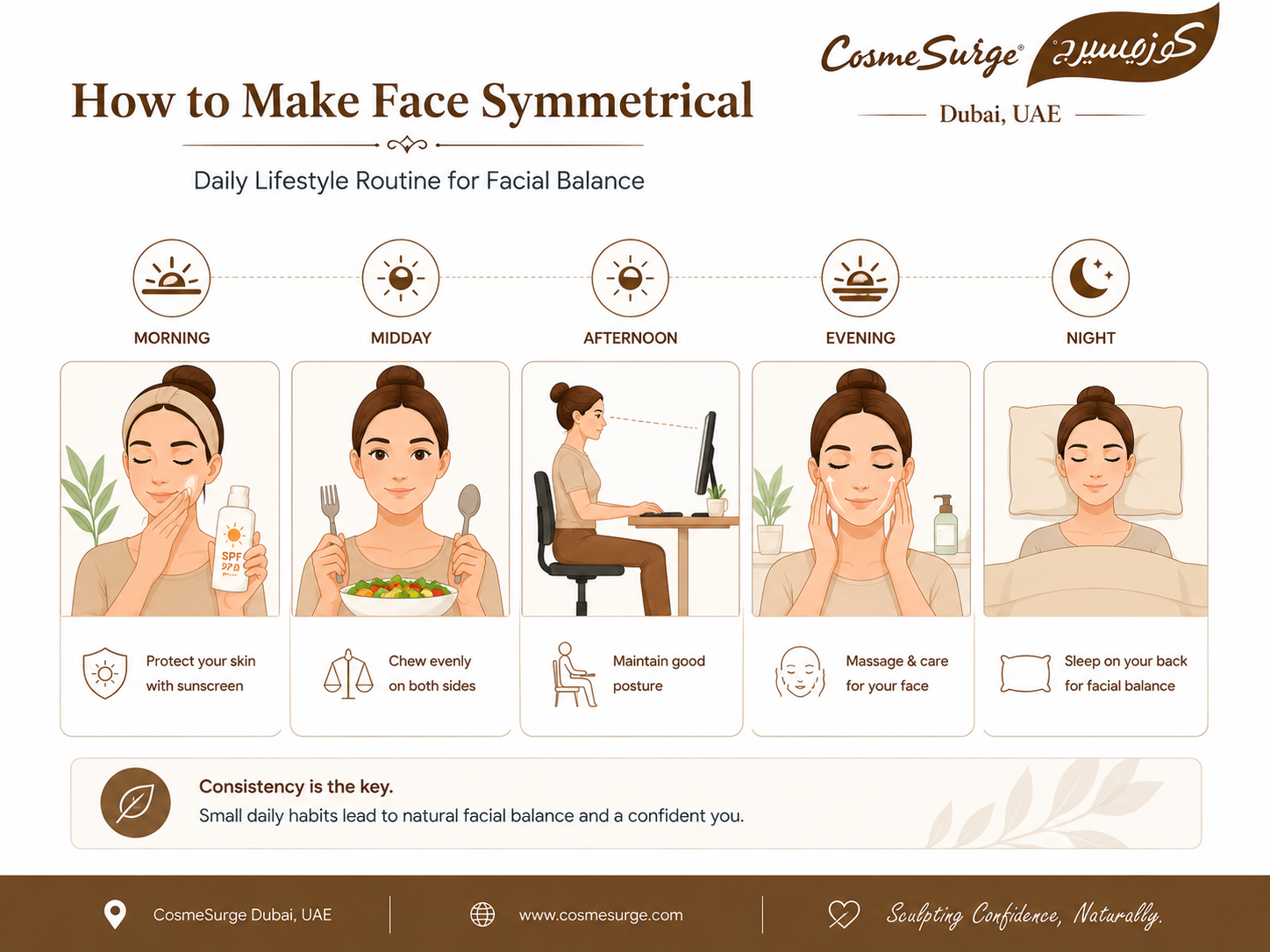
A simple daily symmetry routine
Consistency matters far more than intensity. If you want a realistic plan for how to improve face symmetry at home, the following five-minute routine is easy to stick to:
Morning (1 minute): apply sunscreen evenly to both sides of your face before leaving home.
Midday (2 minutes): do one round of cheek lifts and balanced smile practice, working the weaker side slightly more.
Evening (1 minute): a gentle facial massage on both sides to relax tense muscles and improve circulation.
Night (1 minute): set up your pillow to encourage back-sleeping and wear a night guard if you grind your teeth.
Track your progress with a monthly front-facing photo taken in the same lighting and at the same angle. Subtle, gradual changes are easy to miss day to day, and an honest photo record keeps your expectations realistic while showing whether your habits are helping.
Does Sleeping on One Side Cause Facial Asymmetry?
Many readers specifically ask, “does sleeping on one side cause facial asymmetry?” The realistic answer: sleeping on one side every night can contribute to mild asymmetry over many years, mainly through repeated pressure on the cheek, jaw, and the collagen in your skin. It is rarely the sole cause, but it is a contributing factor you can control.
If you suspect sleep is a factor, the fix is gradual. Train yourself to sleep on your back, support your head with a contoured pillow, and be patient — soft-tissue changes from years of pressure do not reverse overnight. Combined with the exercises above, adjusting your sleep is a practical part of how to reverse facial asymmetry from side sleeping naturally over time.
How to Reverse Facial Asymmetry From Side Sleeping Naturally
People often search for how to reverse facial asymmetry from side sleeping naturally. Although dramatic changes are unlikely, you can gradually improve facial balance by:
Training yourself to sleep on your back.
Using supportive pillows.
Maintaining good posture.
Performing facial exercises regularly.
Avoiding pressure on one side of the face.
Patience is important because soft-tissue changes develop slowly and may take several months to improve.
Asymmetrical Face Treatment Options at a Clinic
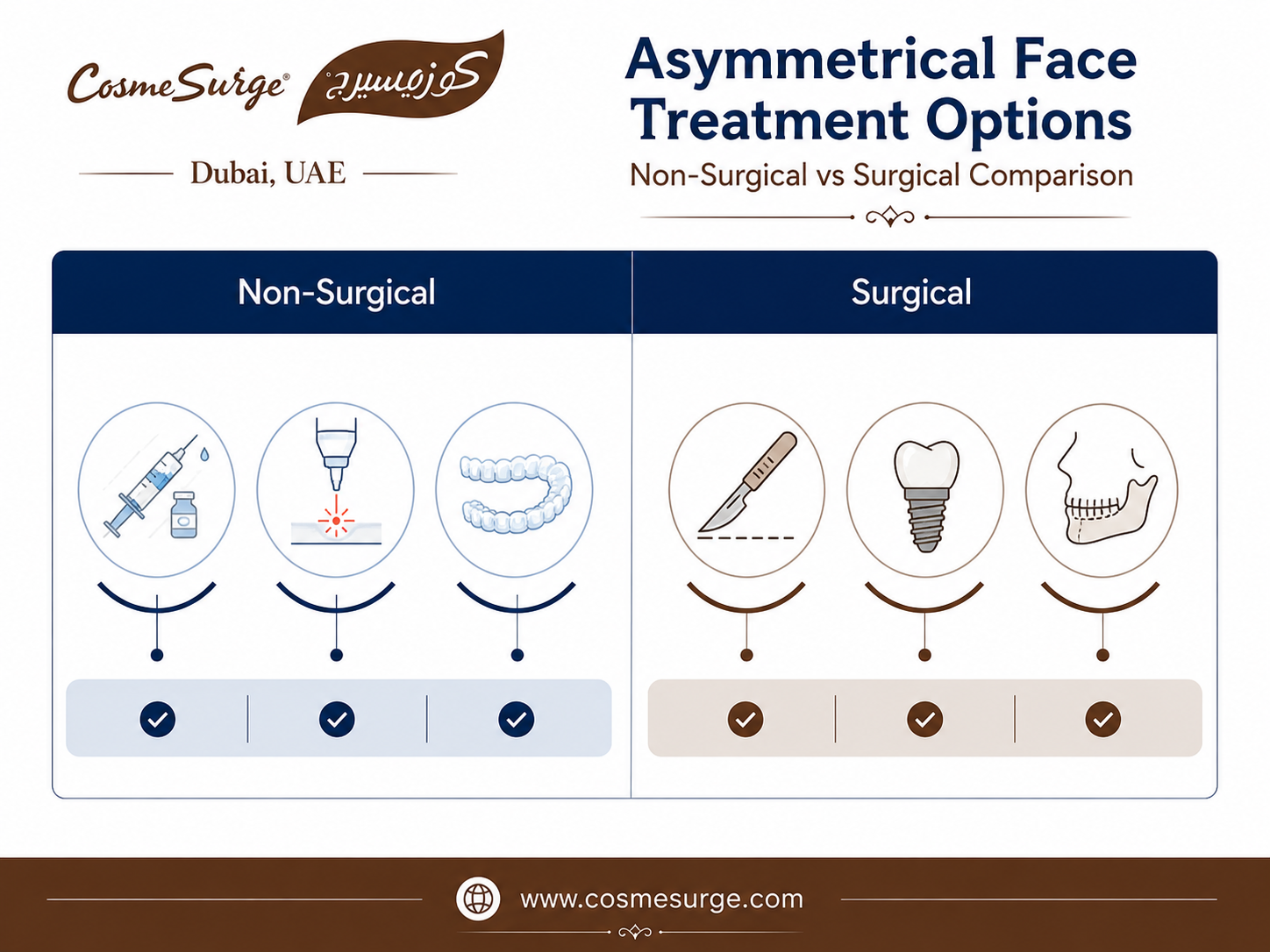
When natural methods are not enough, professional asymmetrical face treatment can produce faster, more noticeable balance. The right facial asymmetry treatment depends on whether the issue is volume, muscle, skin, or bone. A consultation is essential to match the method to your face. Common approaches to facial asymmetry correction include the following.
Dermal fillers
Injectable fillers add volume precisely where one side has less — restoring a flatter cheek, a thinner lip, or a hollow under-eye. This is one of the most popular, non-surgical routes for asymmetrical face correction, with results visible immediately and typically lasting several months to over a year. Because the effect is reversible and adjustable, fillers are often the first clinical option people try when natural methods have not delivered the balance they want.
Muscle-relaxing injections
If asymmetry is driven by an overactive muscle — such as a strong jaw muscle on one side, an uneven smile, or a raised brow — carefully placed injections can soften the dominant side so both match more closely. This is an effective option for muscle-related face asymmetry correction.
This treatment is especially effective for people searching for how to fix facial asymmetry caused by uneven muscle activity.
Skin and energy-based treatments
Laser resurfacing, radiofrequency, and skin-tightening devices can be focused on the more sun-damaged or lax side to even out texture and firmness, helping the two sides age more evenly.
Orthodontics and dental work
When the cause is dental or bite-related, braces, clear aligners, or restorative dentistry can realign teeth and jaw position, which improves the balance of the lower face over time.
Surgical options
For significant skeletal or structural asymmetry, surgical procedures — such as corrective jaw surgery, facial implants, or rhinoplasty for a deviated nose — may be recommended. These deliver the most dramatic and permanent change and are reserved for pronounced cases after thorough assessment.
Here is a quick overview of how cause maps to treatment:
Type of Asymmetry | Natural First Step | Clinical Option |
Habit / muscle (mild) | Exercises, posture, sleep | Muscle-relaxing injections |
Volume loss / aging | Skincare, sun protection | Dermal fillers |
Skin texture / sun damage | Sunscreen, skincare | Laser / RF resurfacing |
Dental / bite | Even chewing, night guard | Orthodontics / aligners |
Skeletal / structural | Professional assessment | Corrective surgery / implants |
People looking to fix asymmetrical face concerns should understand that combining treatments often produces the best and most natural-looking results.
How to Make Your Face Look More Symmetrical Instantly
While the methods above work gradually, a few styling tricks can make your face look more balanced today — useful while you wait for natural changes or treatment results. These do not change your structure, but they are a clever, zero-risk way to enhance a naturally symmetrical face appearance.
Hairstyle and parting
A side parting can balance an uneven forehead or hairline, while layers around the face soften a jaw that looks heavier on one side. Experiment with which side your parting falls on — small changes here have a surprisingly large effect on how even your face reads in photos.
Makeup and contouring
Contouring is one of the fastest ways to even out the face visually. Lightly shading the fuller cheek and highlighting the flatter side creates the illusion of balance. Defining brows so they match in height and shape also makes the upper face look more symmetrical, since the eyebrows frame everything below them.
Beard grooming and glasses
For those with facial hair, shaping a beard slightly fuller on the narrower side helps balance the jawline. Well-fitted glasses that sit level can draw attention to symmetry around the eyes, while the right frame shape can offset an uneven feature. None of these are permanent fixes, but together they are a practical part of looking your best while you address the underlying cause.
Most facial asymmetry is harmless. But certain signs need urgent medical attention rather than cosmetic care. Seek help immediately if you notice:
Sudden drooping on one side of the face, especially with arm weakness or slurred speech — call emergency services, as this can signal a stroke.
New facial weakness or an inability to close one eye or move one side of the mouth, which may indicate Bell’s palsy.
Rapidly increasing swelling that is painful, warm, or accompanied by fever.
Asymmetry following a recent injury or accident.
For long-standing, gradual asymmetry that simply bothers you cosmetically, a consultation with an experienced aesthetic practitioner is the right path. They can identify the cause and recommend whether natural methods, non-surgical treatment, or surgery suits you best.
The Bottom Line
A little unevenness is part of being human — but if it bothers you, you now know how to fix asymmetrical face concerns step by step. Start with the natural habits and exercises, give them a few months, and protect your skin along the way. If you want a clearer, faster result, modern non-surgical and surgical treatments make safe, natural-looking facial asymmetry correction more achievable than ever.
At CosmeSurge, our experienced aesthetic doctors assess the true cause of your facial asymmetry and build a personalised plan — from skincare and injectables to advanced procedures — so your face looks balanced, refreshed, and unmistakably you. Book a consultation to find the right approach for your goals.
Frequently Asked Questions About How to Fix Asymmetrical Face
Here are some answers to the specific questions we often hear but didn’t cover in detail above.
Yes. Every human face is asymmetrical to some degree — perfectly even faces do not exist in nature. Mild, long-standing asymmetry is completely normal and usually unnoticeable to others. It only warrants attention if it is severe, sudden, or affecting your confidence.
It can be improved in most cases. Mild, habit-related asymmetry may respond to exercises, posture, and sleep changes. Volume or muscle issues are treated with fillers or injections, while structural asymmetry may need orthodontics or surgery. Results depend on the underlying cause.
Focus on balanced facial exercises, sleeping on your back, improving posture, chewing evenly, protecting your skin from the sun, and avoiding resting your face on your hand. These help mild asymmetry over weeks to months but cannot change bone structure.
Sleeping on the same side every night for many years can contribute to mild asymmetry through repeated pressure, but it is rarely the only cause. Switching to back-sleeping and using a supportive pillow can help limit and slowly improve the effect.
Common reasons include chewing mainly on one side, teeth grinding, natural fat distribution, sleeping position, or dental issues. If one side becomes suddenly larger, painful, or warm, see a dentist or doctor to rule out infection or swelling.
A crooked smile usually comes from muscle dominance on one side of the mouth, slight differences in the lip-lifting muscles, or dental alignment. It is typically harmless. However, a sudden crooked smile or facial drooping needs emergency medical care.
Uneven chewing, jaw-muscle development, fluid retention from sleeping position, or dental problems are the usual causes. Long-standing, painless differences are normal; new or painful swelling should be checked by a professional.
Natural methods work gradually. Many people notice subtle changes after 6–12 weeks of consistent exercises and habit changes, but soft-tissue improvements can take several months and results vary from person to person.
Yes, in many cases. Non-surgical options such as dermal fillers, muscle-relaxing injections, and energy-based skin treatments can correct volume, muscle, and texture-related asymmetry. Surgery is only needed for significant structural or skeletal cases.
Medical Disclaimer & Review
This content is for educational purposes only and does not replace professional medical advice. Always consult a qualified healthcare provider for diagnosis and treatment.
Medically reviewed by the CosmeSurge Plastic Surgery Team, Dubai,UAE.