For many women, the physical evolution of the body is a journey marked by various milestones—puberty, perhaps pregnancy, weight fluctuations, and the natural progression of time. Among these changes, the shift in the contour and position of the chest is one of the most common topics brought up in clinical consultations. There is often a sense of quiet concern, or even a bit of anxiety, when someone first notices a change in firmness. You might find yourself looking in the mirror and wondering why this is happening now, or if what you are seeing is considered “normal.” In medical terms, we refer to the descent of the breast tissue as breast ptosis, but in everyday conversation, most simply refer to them as saggy breasts.
It is important to start by saying that changes in breast tissue are an almost universal part of the female experience. However, because our culture often prioritizes a specific, unchanging aesthetic, the appearance of saggy breasts can lead to questions about health, aging, and even self-esteem. Understanding the “why” behind these changes requires a look at the intricate anatomy of the chest, the biological factors at play, and the lifestyle influences that shape our bodies. Especially here in the UAE, where we value both health and aesthetic well-being, having a clear, medically grounded understanding of your body helps in making informed decisions about your care.
The Deep Anatomy of the Breast: Why Gravity Wins
When we talk about the medical definition of a saggy breast, we are looking at the relationship between the breast tissue, the nipple-areola complex, and the inframammary fold (the crease where the breast meets the chest wall). In a clinical setting, such as a consultation at CosmeSurge Hospital, Dubai, UAE, a specialist uses a standardized scale to determine the degree of ptosis.
The breast itself does not contain muscle. Instead, it is a collection of glandular tissue, fat, and milk ducts, all held together by a network of thin, fibrous connective tissues called Cooper’s ligaments. These ligaments are the internal “suspension system.” They are anchored to the deep fascia of the chest wall and extend through the breast tissue to the skin.
The Suspension Failure
Imagine these ligaments as the elastic bands of a trampoline. When they are young and tight, they hold the glandular tissue high on the chest wall. However, ligaments are made of collagen, and collagen is susceptible to “creep”—a mechanical term for the gradual stretching that occurs under constant load. When these ligaments stretch or lose their elasticity, the glandular tissue follows the pull of gravity, leading to what is medically termed mammary ptosis.
The Grades of Sagging (The Regnault Scale)
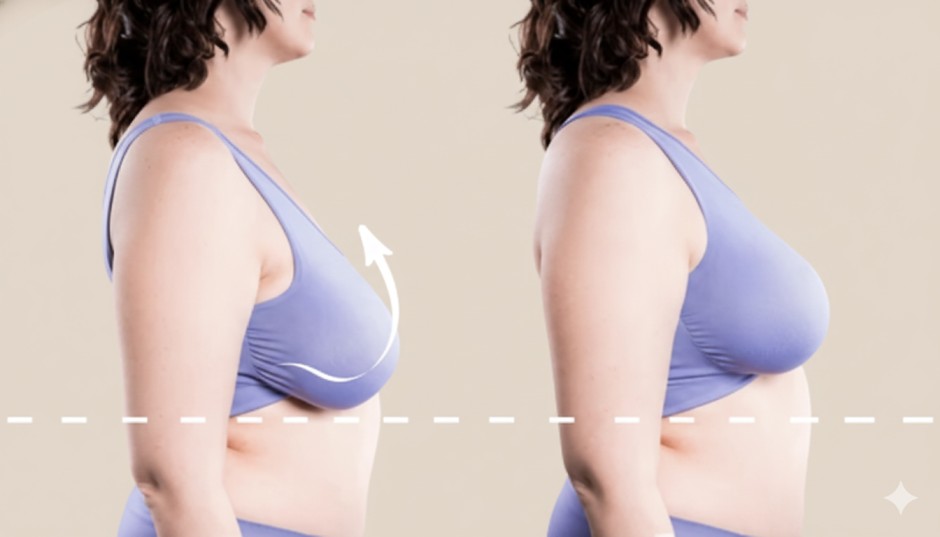
Grade I (Mild): The nipple is at the level of the inframammary fold (the crease).
Grade II (Moderate): The nipple has fallen below the fold but remains above the lowest contour of the breast.
Grade III (Advanced): The nipple is at the lowest point of the breast and points toward the ground.
Pseudoptosis: This is a unique clinical finding where the breast tissue itself has descended, but the nipple remains at or above the fold. This often happens after weight loss when the skin stretches but the nipple position remains stable.
What Causes Saggy Breasts? (A Deep Dive into the "Why")
One of the most frequent questions we hear is: “What causes saggy breasts at a young age?” It is a common misconception that sagging only happens to older women. In reality, the factors that lead to ptosis can affect someone in their late teens just as easily as someone in their 50s.
The Role of Genetics: The Blueprint of Elasticity
Your DNA provides the blueprint for your skin’s elasticity and the thickness of your Cooper’s ligaments. Some women are naturally born with higher concentrations of Type I collagen, which is more resilient. If your mother or grandmother experienced early ptosis, you might have a genetic predisposition toward it as well. Genetics also dictate your breast density; heavier, denser breasts put more constant, 24/7 strain on the internal ligaments.
Weight Fluctuations: The “Accordion Effect”
Significant weight loss is one of the primary causes of sagging breasts. When you gain weight, the skin of the breast—the “skin envelope”—stretches to accommodate new fat cells. If that weight is lost rapidly, the skin may not have enough elastic recoil to “snap back.” This often leaves the breast looking “pendulous”—a term used to describe a breast that has lost its internal volume but kept the stretched-out skin.
Pregnancy: It’s Not the Nursing, It’s the Volume
There is a common myth that breastfeeding is the primary culprit. However, clinical studies suggest it is actually the pregnancy itself. During pregnancy, hormonal surges cause the milk ducts and glands to expand rapidly. This expansion stretches the skin and the ligaments. After pregnancy, once the hormones return to baseline and milk production ceases, the glandular tissue shrinks, but the skin that was stretched often remains loose.
The Biochemistry of Aging (Involution)
As we enter our 30s and 40s, the body’s production of collagen and elastin—the proteins that provide structure—begins to slow down. Furthermore, during menopause, a process called “involution” occurs. The firm glandular tissue is replaced by soft fat. Fat is more susceptible to gravity and less “perky” than glandular tissue, which naturally makes the breasts feel less firm.
Saggy Breasts at a Young Age: The Adolescent Concern
It can be particularly distressing to notice saggy breasts at 16, 18, or 20. In these cases, the cause is rarely “aging.” Instead, it is usually a combination of factors related to development.
Rapid Pubertal Growth
If the breasts grow very quickly during puberty, the skin may stretch beyond its “yield point” before the internal ligaments have time to strengthen. This is a common reason for early ptosis in teenagers.
High-Impact Stress
For active young women, high-impact exercise (like running or jumping) without a properly fitted, supportive sports bra can cause “micro-trauma” to the Cooper’s ligaments. Over time, these tiny stretches add up to a noticeable change in breast position.
Hormonal Sensitivity
Some individuals have breast tissue that is particularly sensitive to the monthly hormonal cycle. If the breasts swell significantly before a period and then “deflate” afterward, this repeated fluctuation can wear down the skin’s resilience, much like stretching a balloon over and over again.
Lifestyle Influences: The Accelerants of Ptosis
While we cannot change our genetics, certain external factors can accelerate the breakdown of the skin envelope.
Smoking and Elastin Degradation
If there is one thing a surgeon at CosmeSurge Hospital, Dubai, UAE will emphasize, it is that smoking is a major risk factor for early ptosis. The chemicals in cigarettes break down elastin fibers throughout the body. In the breast, this means the skin loses its ability to hold weight, leading to premature sagging.
Sun Damage on the Decolletage
We often protect our faces but forget our chests. UV radiation breaks down the collagen in the thin skin of the chest. When this skin becomes weak and “crepey,” it can no longer assist the internal ligaments in supporting the weight of the breast tissue.
The “Bra Myth” vs. Clinical Reality
Does wearing a bra prevent sagging? Or does not wearing one make it worse? The clinical data is mixed. While a bra provides external support and can prevent discomfort, there is no evidence that it prevents the long-term, biological stretching of ligaments. However, we do know that not wearing a sports bra during intense physical activity almost certainly contributes to ligamentous damage.

When Should You Seek a Medical Evaluation for Saggy Breast?
For the vast majority of women, having a saggy breast is a cosmetic change and not a health risk. However, there are times when a change in position can indicate something more:
Sudden Asymmetry: If one breast begins to sag significantly faster than the other, it could indicate a change in the underlying tissue.
Skin Changes: If the sagging is accompanied by “dimpling” (like an orange peel), redness, or thickening of the skin, this requires immediate medical attention.
Physical Pain: Large, pendulous breasts can cause chronic neck, back, and shoulder pain, often leading to deep grooves from bra straps.
Psychological Distress: If the change in your appearance is significantly affecting your quality of life, a clinical discussion is warranted.
At CosmeSurge Hospital, Dubai, UAE, the diagnostic process is comprehensive. A specialist will often combine a physical exam with a review of your mammogram or ultrasound history to ensure the tissue is healthy before any aesthetic discussions begin.
Management and Realistic Expectations
While this guide focuses on the “why,” it is worth noting that for those who are bothered by the change, there are clinical paths forward. These range from non-invasive skin-tightening treatments to surgical procedures like a mastopexy (breast lift).
The goal of modern medicine is to provide options that align with your lifestyle. For some, simply finding the right supportive garments and understanding that their body is behaving “normally” is enough. For others, a more permanent structural correction is desired. Regardless of the path, the most important step is a consultation rooted in trust and clinical expertise.
Closing Thoughts: Embracing Your Journey
The human body is remarkably resilient, but it is not static. It is designed to adapt to the phases of our lives—growth, nurturing, and aging. While a saggy breast might be a source of frustration, it is also a testament to the life your body has lived.
There is power in understanding the “why.” It removes the mystery and the shame. If you are bothered by the changes you see, remember that you are in control of your journey. Modern medicine offers many pathways to restoration, but the first step is always accurate information and a healthy perspective. At CosmeSurge Hospital, Dubai, UAE, our goal is to support that journey, ensuring that every woman feels empowered and informed about the body she lives in.
Frequently Asked Questions
Yes. It is a natural biological progression. Most women will experience some degree of sagging due to gravity, aging, and the natural loss of skin elasticity over time.
In teenagers, sagging is usually due to genetics or rapid growth during puberty. If the breast tissue grows faster than the skin can accommodate, it can lead to early ptosis.
No. Multiple clinical studies have shown that breastfeeding does not increase the risk of sagging. It is the pregnancy itself—and the associated volume and hormonal changes—that stretches the ligaments.
There is no medical evidence that wearing a bra 24/7 prevents sagging. Sagging is caused by internal changes in the ligaments and skin, which occur regardless of whether you are wearing a bra while sleeping.
The pencil test is an informal check for sagging. If you can hold a pencil under your breast fold without it falling, you have a degree of ptosis. However, doctors use more precise clinical measurements to grade the sagging.
Rapid or significant weight loss often leads to sagging because the skin envelope does not have time to shrink as the fat inside the breast disappears. Slow, controlled weight loss and strength training can sometimes help mitigate this.
Yes. Smoking is a significant contributor to premature sagging. It reduces blood flow to the skin and destroys the elastin fibers that provide structural support.
Yes. You inherit your skin’s collagen density and the strength of your Cooper’s ligaments from your parents. If your mother had early sagging, you are more likely to experience it as well.
During pregnancy, your breasts expand with glandular tissue and milk. Once you stop nursing, that tissue shrinks, often leaving behind “extra” skin that can no longer support the breast’s original position.
Most women begin to notice changes in their late 20s or early 30s, as this is when the body’s natural production of collagen and elastin starts to decline.
Exercise can strengthen the pectoral muscles behind the breast, which can provide a more firm “base” for the breast tissue, but it cannot change the position of the nipple or tighten stretched skin.
Sagging itself is not a sign of cancer. However, if you notice a sudden change in shape, skin dimpling, or a lump along with the sagging, you should consult a doctor immediately.
This is a condition where the breast looks saggy because the tissue has settled lower on the chest, but the nipple itself is still in a high, youthful position.
Yes. Sun damage (photo-aging) destroys collagen. If the skin on your chest is sun-damaged, it becomes less able to support the weight of the breasts.
If the appearance of your breasts is causing you chronic physical pain or if the emotional distress is affecting your daily life, a consultation is a good first step to understand your options.
Medical Disclaimer & Review
Content on the CosmeSurge website is for informational and educational purposes only and does not replace professional medical advice, diagnosis, or treatment. Always consult a qualified healthcare professional for medical concerns and never delay seeking advice based on this content. In emergencies, contact your doctor or local emergency services immediately. All website content is reviewed by qualified medical professionals to ensure accuracy and alignment with current evidence-based practices.