

Waking up with a refreshed, vibrant appearance is a universal goal, yet many find that despite a perfect sleep schedule, the mirror reveals persistent puffiness. When topical creams and lifestyle adjustments no longer suffice, patients often begin to explore how to remove eye bags permanently to achieve a more rested look. In a clinical context, the journey toward rejuvenation is not about “miracles” but about understanding the intricate anatomy of the periorbital area and matching the right intervention—whether surgical or non-surgical—to a patient’s specific needs. At CosmeSurge Hospital, Dubai, UAE, our approach prioritizes a deep clinical understanding of why these changes occur, ensuring that every patient receives an ethical, scientifically grounded plan for their unique facial structure.
Understanding the Structural Shift: Why Do Bags Become Permanent?
To determine the most effective approach for management, we must first distinguish between temporary puffiness and structural “bags.” Temporary swelling is often the result of fluid retention (edema) caused by dietary salt, allergies, or a lack of sleep. In contrast, permanent eye bags are typically a result of fat herniation.
Beneath our eyes sits a collection of specialized fat pads that cushion the globe. These are held in place by a thin, fibrous wall known as the orbital septum. As we age, or due to genetic predisposition, this septum can weaken and stretch. When the “wall” gives way, the fat pads bulge forward, creating a protrusion that does not fluctuate with sleep or hydration. For these individuals, knowing how to remove eye bags permanently involves addressing either the position of that fat or the strength of the skin and muscle holding it back.
The Genetic Component
It is not uncommon to see patients in their early twenties presenting with noticeable lower lid bags. In these cases, the issue is often hereditary facial architecture rather than aging. Genetics dictate the strength of your ligaments, the shape of your orbital bone, and the positioning of your fat pads. For those with a strong family history of under-eye concerns, structural intervention is often the only pathway to a visible, lasting change.
Non-Surgical Pathways: Refining the Under-Eye Contour
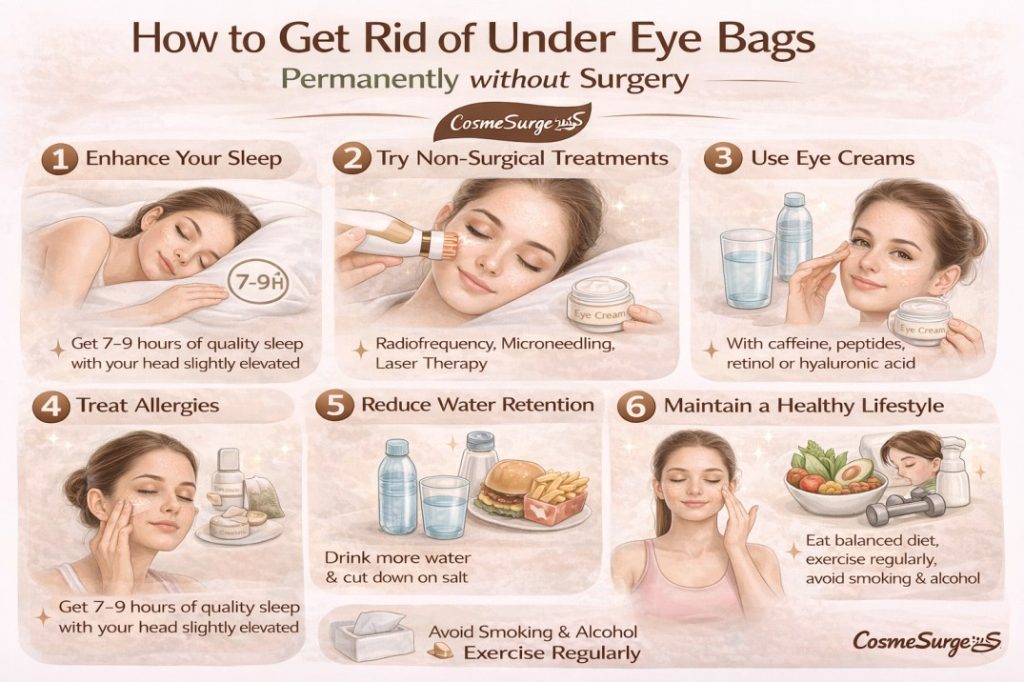
For many patients, the thought of surgery is daunting, leading them to seek ways on how to remove eye bags permanently or semi-permanently without an operating room. While only surgery can physically remove tissue, modern aesthetic medicine offers highly effective ways to “camouflage” or tighten the area with minimal downtime.
1. Dermal Fillers (The “Invisible” Correction)
In a significant number of cases, what appears to be a protruding bag is actually an illusion created by a deep hollow beneath it, known as the tear trough. When the cheek loses volume, it leaves a shadow that makes the fat pad above look larger.
The Clinical Approach: By precisely injecting a hyaluronic acid-based gel into this hollow, a specialist can smooth the transition between the eye and the cheek.
The Result: The shadow is eliminated, and the “bag” appears to vanish. While not permanent—fillers typically last 9 to 18 months—this is a powerful, non-invasive tool for the right candidate.
2. Laser Resurfacing and Energy-Based Devices
When the concern is “crepey” or lax skin rather than large fat pads, energy-based treatments are often recommended. At CosmeSurge Hospital, Dubai, UAE, we may utilize Fractional CO2 lasers or Radiofrequency (RF) to stimulate the body’s natural regenerative processes.
Mechanism: These devices deliver controlled thermal energy to the deeper dermal layers, causing immediate contraction of collagen fibers and triggering the production of new elastin.
Long-Term Benefit: Over several months, the skin becomes thicker and more resilient, providing a firmer “envelope” that holds the underlying structures in place more effectively.
3. Advanced Radiofrequency (RF) Microneedling
A newer frontier in non-surgical care involves RF microneedling, which can specifically target small pockets of fat. By delivering energy directly into the fat pad via specialized needles, clinicians can achieve a modest reduction in volume while simultaneously tightening the skin. This is often a middle-ground for patients who are not yet ready for surgery but require more than just a topical solution.
The Definitive Solution: Lower Blepharoplasty
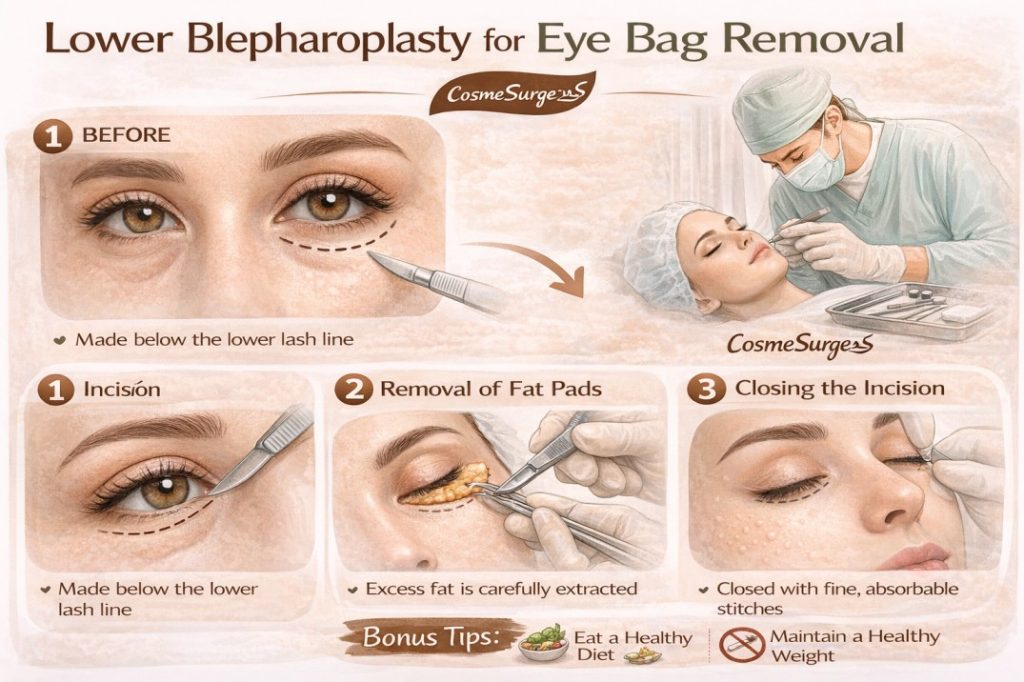
When fat herniation is significant or when there is an excess of sagging skin, surgical intervention remains the gold standard for those asking how to remove eye bags permanently. Eyelid surgery, or blepharoplasty, is a delicate procedure designed to provide a comprehensive structural correction.
The Transconjunctival Approach (No Visible Scars)
For younger patients or those with good skin elasticity, surgeons often prefer the transconjunctival method. The incision is made on the inside of the lower eyelid.
Benefit: There are no external scars, and the surgeon has direct access to the fat pads.
Fat Repositioning: Rather than simply removing the fat (which can sometimes lead to a “hollowed-out” look), modern surgeons often move or “reposition” the fat into the tear trough area. This achieves a natural, youthful fullness while removing the bag.
The Subciliary Approach (Skin & Muscle Tightening)
If the patient has a significant amount of excess, wrinkled skin, a subciliary incision is made just beneath the lower lashes. This allows the surgeon to trim away the redundant skin and, if necessary, tighten the underlying muscle (the orbicularis oculi) to provide a more lifted appearance.
Clinical Realities: Risks, Recovery, and Expectations
Every clinical procedure, regardless of how routine, carries its own set of considerations. A transparent discussion about what to expect is a hallmark of ethical medical care.
The Recovery Journey
Recovery from a lower blepharoplasty typically unfolds over two weeks:
Days 1-3: Patients should expect swelling and bruising, which usually peaks on the second or third day. Cold compresses and keeping the head elevated are essential during this phase.
Days 5-7: Stitches (if any) are typically removed. Most patients feel comfortable enough to work from home, though social downtime may continue.
Week 2: Bruising typically fades to a light yellow and can often be concealed with mineral makeup. Most patients return to their social routines looking refreshed.
Months 3-6: The final results settle as residual internal swelling resolves and incision lines mature.
Understanding the Limitations
While we discuss how to remove eye bags permanently, it is important to remember that surgery resets the clock—it does not stop it. The skin will continue to age naturally. Maintaining results requires a commitment to sun protection, a healthy lifestyle, and perhaps occasional non-surgical “maintenance” treatments.
When to Seek a Professional Consultation
Self-diagnosis is often difficult because several different conditions can mimic eye bags. For instance, “malar mounds” or “festoons” are swellings located lower on the cheekbone and require a completely different treatment approach than standard infraorbital fat bags.
A consultation at a specialized facility like CosmeSurge Hospital, Dubai, UAE, provides the opportunity for a physical examination, including the “pinch test” to evaluate skin laxity and the “press test” to confirm the presence of herniated fat. This ensures that the proposed solution addresses the actual anatomical cause rather than just the symptom.
Conclusion: A Restored Perspective
Deciding how to remove eye bags permanently is a significant step toward feeling more confident and refreshed. Whether you opt for the subtle, immediate refinement of dermal fillers or the comprehensive structural correction of a blepharoplasty, the goal is always a natural, harmonious result. By seeking professional guidance and understanding the clinical realities of each treatment, you can ensure that your path to rejuvenation is safe, ethical, and tailored to you. At CosmeSurge Hospital, Dubai, UAE, we remain dedicated to the principle that informed patients achieve the best outcomes, helping you see the world and yourself with newfound clarity.
Frequently Asked Questions (FAQs)
Here are some answers to the specific questions we often hear but didn’t cover in detail above.
At-home remedies like cold compresses, tea bags, and cucumber slices are excellent for reducing temporary puffiness caused by fluid. However, they cannot remove the structural fat pads that cause permanent eye bags.
The results of a lower blepharoplasty are considered long-lasting, often remaining stable for 10 to 15 years or more. While the fat removed does not “grow back,” the surrounding skin and muscles will continue to age naturally over time.
Surgical removal is performed under local anesthesia with sedation or general anesthesia, so the procedure itself is painless. Afterward, most patients report a feeling of “tightness” or mild soreness rather than sharp pain, which is typically managed with standard over-the-counter medication.
When administered by a qualified specialist, dermal fillers are a very safe way to improve the appearance of the under-eye area. However, they are a temporary solution and work best for “hollows” rather than large fat bulges.
Most patients require 7 to 10 days of social downtime. While you may feel physically fine within a day or two, visible bruising and swelling take time to resolve.
It depends on the cause. If your dark circles are caused by a shadow from the bag, surgery or fillers will help significantly. If they are caused by thin skin or pigment, you may need additional treatments like chemical peels or specialized lasers.
Patients are typically advised to avoid contact lenses for about two weeks following a blepharoplasty to avoid irritating the healing tissues. Glasses are a suitable alternative during this time.
Common side effects include temporary dry eyes, swelling, and bruising. Rare risks include asymmetry, infection, or issues with eyelid positioning (ectropion), which is why choosing an experienced surgeon is vital.
Yes. Many patients use lasers or fillers years after their surgery to maintain the skin’s quality and address the natural volume loss that occurs with further aging.
Not always. Many lower blepharoplasty procedures can be performed comfortably under local anesthesia with “twilight” sedation, allowing for a faster initial recovery.
Even with permanent, structural bags, fluid retention can sit on top of the fat pads, making them look larger after a salty meal, a night of poor sleep, or during allergy season.
Yes. Certain medical conditions, such as thyroid eye disease, can cause changes in the eye area. A specialist will review your medical history to ensure your bags are cosmetic and not a symptom of an underlying health issue.
There is no “correct” age. The decision is based on your anatomy and how much the concern affects your quality of life. We see patients ranging from their late twenties to their seventies.
With a transconjunctival approach, there are no external scars. With a subciliary approach, the fine line is hidden just beneath the lashes and typically fades to a point where it is nearly invisible to the naked eye.
This choice is best made during a clinical consultation. Generally, if your primary issue is a hollow, fillers are ideal. If your primary issue is protruding fat or excess skin, surgery is the more effective choice.
Medical Disclaimer & Review
Content on the CosmeSurge website is for informational and educational purposes only and does not replace professional medical advice, diagnosis, or treatment. Always consult a qualified healthcare professional for medical concerns and never delay seeking advice based on this content. In emergencies, contact your doctor or local emergency services immediately. All website content is reviewed by qualified medical professionals to ensure accuracy and alignment with current evidence-based practices.